This area will cover relevant news of the threat to the planet from Near Earth Objects (NEOs) including concepts and designs for mitigation. All opinions are those of the author.

25 June 2008

Evidence Of Massive Asteroid Impact On Mars Supported By Computer Simulations


From the ScienceDaily Article...

The dramatic differences between the northern and southern hemispheres of Mars have puzzled scientists for 30 years. One of the proposed explanations--a massive asteroid impact--now has strong support from computer simulations carried out by two groups of researchers. Planetary scientists at the University of California, Santa Cruz, were involved in both studies, which appear in the June 26 issue of Nature.

"It's a very old idea, but nobody had done the numerical calculations to see what would happen when a big asteroid hits Mars," said Francis Nimmo, associate professor of Earth and planetary sciences at UCSC and first author of one of the papers.

Nimmo's group found that such an impact could indeed produce the observed differences between the Martian hemispheres. The other study used a different approach and reached the same conclusion. Nimmo's paper also suggests testable predictions about the consequences of the impact.

The so-called hemispheric dichotomy was first observed by NASA's Viking missions to Mars in the 1970s. The Viking spacecraft revealed that the two halves of the planet look very different, with relatively young, low-lying plains in the north and relatively old, cratered highlands in the south. Some 20 years later, the Mars Global Surveyor mission showed that the crust of the planet is much thicker in the south and also revealed magnetic anomalies present in the southern hemisphere and not in the north.

"Two main explanations have been proposed for the hemispheric dichotomy--either some kind of internal process that changed one half of the planet, or a big impact hitting one side of it," Nimmo said. "The impact would have to be big enough to blast the crust off half of the planet, but not so big that it melts everything. We showed that you really can form the dichotomy that way."

Nimmo's group includes UCSC graduate student Shawn Hart, associate researcher Don Korycansky, and Craig Agnor of Queen Mary University, London. The other paper is by Margarita Marinova and Oded Aharonson of the California Institute of Technology and Erik Asphaug, professor of Earth and planetary sciences at UCSC.

The quantitative model used by Nimmo's group calculated the effects of an impact in two dimensions. Asphaug's group used a different model to calculate impacts in three dimensions, but with lower resolution (i.e., less detail in the simulation).

"The two approaches are very complementary; putting them together gives you a complete picture," Nimmo said. "The two-dimensional model provides high resolution, but you can only look at vertical impacts. The three-dimensional model allows nonvertical impacts, but the resolution is lower so you can't track what happens to the crust."

Most planetary impacts are not head-on, Asphaug said. His group found a "sweet spot" of impact conditions that result in a hemispheric dichotomy matching the observations. Those conditions include an impactor about one-half to two-thirds the size of the Moon, striking at an angle of 30 to 60 degrees.

"This is how planets finish their business of formation," Asphaug said. "They collide with other bodies of comparable size in gargantuan collisions. The last of those big collisions defines the planet."

According to Nimmo's analysis, shock waves from the impact would travel through the planet and disrupt the crust on the other side, causing changes in the magnetic field recorded there. The predicted changes are consistent with observations of magnetic anomalies in the southern hemisphere, he said.

In addition, new crust that formed in the northern lowlands would be derived from deep mantle rock melted by the impact and should have significantly different characteristics from the southern hemisphere crust. Certain Martian meteorites may have originated from the northern crust, Nimmo said. The study also suggests that the impact occurred around the same time as the impact on Earth that created the Moon.

This research was funded by NASA.

ScienceDaily
25 June 2008

Link: ScienceDaily

Link: Nature Magazine Article

Link: Computer simulation

Link: Space.com article

Link: University of Santa Cruz Press Release

Link: MIT Press Release

Link: National Public Radio (NPR) Story: "Mars May Have Been Struck by Massive Object"

U.S. Senate Committee on Commerce, Science, and Transportation passes NASA Authorization Legislation: NEO Inclusion

The U.S. Senate's Committee on Commerce, Science, and Transportation just passed "The National Aeronautics and Space Administration Authorization Act of 2008" (essnetailly its version of H.R. 6063 that passed in the House). The legislation seems to have multiple elements (similar to H.R. 6063). The press release from the committee indicates some support of NEO activity, specifically the following...

The bill also includes studies on field center leasing practices and project and work allocation; an interagency study of commercial space launch range facilities; a study on the impact of export control policies related to the aerospace industry; and an expression of support for the Near-Earth Object Survey to detect and identify near-Earth objects.

Link: Press Release (Commerce Committee Approves National Aeronautics and Space Administration Authorization Act of 2008)

22 June 2008

New Discovery Channel Canada Documentary: "Asteroid Trackers"

Monday, June 30 2008 at 7pm ET/8pm PT and simulcast on Discovery HD at 7pm ET/4pm PT, Discovery Channel Canada presents a new documentary on asteroid mitigation. Discovery Channel segment producer Barb Ustina is the person behind this new documentary.

From the show website...

Discovery Channel Scours the Skies for Near-Earth Objects on a Collision Course with Our Planet in Asteroid Trackers, June 30

Just after 7 a.m. on June 30, 1908, a mysterious explosion occurred in the remote area of Tunguska in Siberia. With only overturned trees and singed branches as evidence of this event, scientists are still uncovering data about that collision - and other asteroids - that may be headed straight for us.

On the 100th anniversary of the Tunguska event, Discovery Channel presents Asteroid Trackers, a one-hour original Canadian special that looks at efforts to track Apophis, an asteroid due to come dramatically - and dangerously - close to Earth in 2029 and again in 2036.

Premiering Monday, June 30 at 7pm ET/8pm PT and simulcast on Discovery HD at 7pm ET/4pm PT, this compelling special delves into various facets of asteroid research around the world.

Shot entirely in High Definition and hosted by Daily Planet's Jay Ingram on location from a crater site in Arizona, Asteroid Trackers reveals how experts are attempting to protect the world from near-Earth objects (NEOs). Whether it's determining the composition of the asteroids so they can be destroyed effectively or swarming them with reflective mirrors, find out which deflection methods are pushing the boundaries of technology to protect the planet from yet another cosmic collision.

Highlights from Asteroid Trackers include:

Using one of the world's fastest super computers, Sandia National Laboratories nuclear research investigator Mark Boslough has demonstrated that the asteroid which blasted Tunguska 100 years ago was smaller than experts previously thought. This discovery has strong implications about the size of an asteroid and the amount of damage it can cause. It also begs the question: Do we have more to fear from the numerous small asteroids in our solar system than from the thousands of big ones experts have already identified?

Based on craters studied so far, the planet has been hit by a large asteroid approximately every 100 years, which means we may be due for another one soon. Watch as University of Arizona's violent impact specialist Jay Melosh demonstrates his idea to change an asteroid's course. Using a very simple technique, Melosh is proposing a new way of preventing another cosmic collision - provided we have 10 years' notice.

Most asteroids are discovered by well established research teams, but in an effort to identify and track rogue asteroids, amateur astronomers are also very helpful. Meet Roy Tucker, a passionate astronomer who keeps his eye on the sky in a Tucson, Arizona, suburb. Tucker and his friend were the first to identify Apophis, an asteroid due to come perilously close to Earth in 2029, and possibly again in 2036. See how his constant communication with Harvard Smithsonian's Minor Planet Centre helps experts keep track of dangerous near-Earth objects.

Link: Discovery Channel Canada Show Link

Link: Discovery Channel Press Release

U.S. Congressman Dana Rohrabacher's Comments on Use of Russian Radar for Asteroid Investigations

U.S. Congressman Dana Rohrabacher's recent visit to Russia had some space related themes (including NEOS). One of the items that the Congressman discussed was the use of Russia's RT 70 radar for asteroid tasks. Some Russian news outlets seem to have taken this to indicate NASA's intention to use this radar, which may not be the case since I am unsure if that is exactly what the Congressman probably suggested. This seems to be getting some attention from Russian News agencies. Selections from various articles follow...

U.S.-Russian cooperation in space was discussed during U.S. House of Representatives Congressman Dana Rohrabacher's visit to the rocket and space corporation Energia in Moscow, Russian space agency Roscosmos reported.

Rohrabacher met with Energia head Vitaly Lopota for talks that were also attended by NASA representatives, Roscosmos said on its website.

"The parties expressed the opinion that cooperation between the two space powers in major space projects, including the International Space Station (ISS), is very effective, while a flight to Mars could give the generations to come a lot more than manned flights to the Moon," Roscosmos said.

The talks dealt with the safety of Soyuz flights, the operation of the ISS and the future of Russian-U.S. cooperation in space, it said. "U.S. Congressman Rohrabacher said that he personally did not doubt the reliability and flight safety of the Russian manned spacecraft Soyuz," Roscosmos said.

"The U.S. congressman also said that Russia and the United States could launch large-scale space projects in the future. A Moon base project and the protection of the earth from asteroids deserve priority attention, he said," according to the Roscosmos posting.

"Russia, U.S. Could Jointly Run Space Projects"
redOrbit.com
04 June 2008

Link: redOrbit Article

Congressmen suggested a Russian telecommunication center in the Primorye Territory, in the Far East, could be used for early warning and detection of dangerous asteroids.

Perminov said the RT 70 radar deployed in the town of Galenki near Ussuriisk (the second largest city in Primorye) is a facility used by Russia's Space Forces.

Link: RIA Novosti Article

The House of Representatives of the US Congress approved the NASA budget in the amount o 20.2 billion dollars Wednesday, RIA Novosti reports. The budget bill contains an amendment about the strengthening of NASA’s cooperation with Russia and other countries within the scope of the program which develops protection against a possible asteroid impact. US congressmen plan to use Russia’s RT-70 radar for the purpose.

Anatoly Perminov, the head of Russia’s Space Agency Roscosmos, told RIA Novosti that the agency positively estimated the initiative from the US Congress. The official said that it could be possible to make a definitive decision on the matter only with the participation of the Russian Defense Ministry. Anatoly Perminov added that the asteroid danger issue should be discussed on the top presidential level.

"NASA to use Russian radar to save USA from asteroids"
Pravda
19 June 2008

Link: Pravda Article

Additional Notes on H.R. 6063

Here are some additional items on H.R. 60603 related to NEOs not mentioned in the previous post. We will see how the Senate reacts to this and then the final compromise legislation. Specific items of interest include the following:

1. Authorizes $2,000,000 to continue planetary radar operations at the Arecibo Observatory in support of the Near-Earth Object program

2. In SEC. 1106. INNOVATION PRIZES. there were comments related to the use of innovation prizes (the NASA Centennial Challenges program). There was a specific item that stated the following:

(a) In General- Prizes can play a useful role in encouraging innovation in the development of technologies and products that can assist NASA in its aeronautics and space activities, and the use of such prizes by NASA should be encouraged.

(b) Amendments- Section 314 of the National Aeronautics and Space Act of 1958 is amended--

(1) by amending subsection (b) to read as follows:

`(b) Topics- In selecting topics for prize competitions, the Administrator shall consult widely both within and outside the Federal Government, and may empanel advisory committees. The Administrator shall give consideration to prize goals such as the demonstration of the ability to provide energy to the lunar surface from space-based solar power systems, demonstration of innovative near-Earth object survey and deflection strategies, and innovative approaches to improving the safety and efficiency of aviation systems.'; and

(2) in subsection (i)(4) by striking `$10,000,000' and inserting `$50,000,000'.

1st IAA Planetary Defense Conference: 27-29 April 2009, Granada, Spain

Following on the 2004 and 2007 Planetary Defense Conferences, there will be an international conference in 2009 on planetary defense.

The 1st IAA Planetary Defense Conference: Protecting Earth from Asteroids will be held in 2009. This will be a three-day conference, sponsored by the International Academy of Astronautics (IAA) and the European Space Agency, and will be held in Granada, Spain on Monday through Wednesday, April 27-29, 2009.

More Backgound on Study from Some Within NASA for a Human Mission to An Asteroid using Constellation Elements

More background on the study by some within NASA for a human mission to an asteroid...selections from the article...

The B612 Foundation proposes a rendezvous with a space rock for weeks or months, during which the robot spacecraft would act as a “gravity tractor,” using its own minuscule gravitational pull to tug the asteroid onto a new course. While B612 spread its message, Ed Lu went on to spend six months aboard the International Space Station. Three months after his return to Earth, in January 2004, the Bush administration announced its Vision for Space Exploration, an ambitious call to send astronauts beyond Earth orbit for the first time since 1972. While NASA set up Constellation and began focusing on the lunar return, targeted for 2020, Lu and the Asteroid Underground quietly pondered other possibilities.

“When NASA unveiled the concepts of the Ares I and V launch vehicles and [the] Orion [crew capsule],” remembers Lu, “I started wondering, ‘Hey, we have these rockets at our disposal. What else can we do?’ ”

By the summer of 2006, Lu, Tom Jones, and Dave Korsmeyer, an engineer at NASA’s Ames Research Center who specializes in celestial mechanics, were conferring regularly with more than a dozen colleagues around the country, asking about the capabilities of Constellation and writing papers. NASA agreed to fund a feasibility study through its Advanced Projects Office that would examine how to use the Orion and Ares hardware to send people to a near-Earth asteroid. Korsmeyer managed the group. After many phone calls and e-mails among the 17 members of the study team, the first meeting took place at the Johnson Space Center in Houston in August 2006. Subsequent gatherings, about one per month, were convened at various NASA centers around the country. By the end of the year, the group had come to the conclusion that NASA’s new hardware could in fact carry humans to a NEO.

In the Asteroid Underground, [Bob] Farquhar is something of an elder statesman and is known for his outspokenness. Having taken part in a recent feasibility study for the International Academy of Astronautics that looked at different options for moving beyond Earth orbit, he doesn’t like the idea of making do with existing Constellation hardware for a stripped-down asteroid mission. “You’d need a transfer vehicle,” he says. “Something big and roomy. And you don’t want it in low Earth orbit all the time.” Instead, he would park an interplanetary, or inter-asteroidal, transfer vehicle at the L2 libration point, about a million miles outside Earth’s orbit, where the gravitational pulls of the sun and Earth are balanced. The transfer vehicle would pick up the crew members in Earth orbit, take them to an asteroid (or, someday, Mars), and then, at journey’s end, return them to Earth orbit.

Dave Korsmeyer has been optimistic about NASA’s interest in asteroids ever since he briefed Constellation manager Jeff Hanley on his study group’s findings in February 2007. “Hanley said, ‘This is great!’ He said the best thing for us to know is that this [Constellation] architecture goes to more than one place instead of just ’round the block.

“Every month since, we’ve been giving a briefing to someone, and not because we’re pushing it. They’re asking for it.” A more detailed study, he says, may be forthcoming.

Rob Landis, a member of the study group with experience in mission control, says, “Apollo 8 was never intended to go to the moon. But NASA said, ‘What if we go anyway?’ That was a huge, quantum leap. I’d say that an asteroid mission is the Apollo 8 of the next generation—before jumping off to Mars, before dipping our toes deeper in that cosmic ocean.”

"The Million Mile Mission: A small band of believers urges NASA to take its next step—onto an asteroid."
Michael Klesius
Air & Space Magazine
01 July 2008

Link: Air & Space Magazine Article

21 June 2008

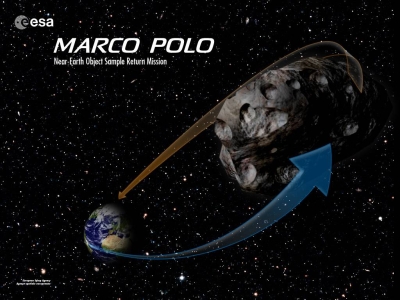
ESA Marco Polo Mission Overview from June 2008 Workshop (and presentations)


From the announcement of the Marco Polo Workshop, a short overview of the Marco Polo mission. Please see the announcement that follows as well as the links for the presentations given at the June 2008 Workshop. Some interesting points observed from the presentations include that NASA is potentially interested in contributing to Marco Polo as a Mission of Opportunity ($35M). This comes from the OSIRIS mission overview presentation (available at the workshop site, see link below).

From the overview of the June 2008 Workshop, there is a good overview of the Marco Polo mission...

Marco Polo is a Near-Earth Object sample return mission studied within the Cosmic Vision programme. It was proposed by Antonella Barucci and a team of several hundred scientists in Europe to ESA in 2007 and is currently undergoing an assessment study.

Marco Polo was proposed in response to ESA's call for mission proposals as part of the new Cosmic Vision programme, suggesting missions with a launch date between 2015 and 2025. The lead proposers are Antonella Barucci from the Observatoire de Paris-Meudon and M. Yoshikawa from the Japanese space agency JAXA. They were supported by a core team of six scientists in Europe, two scientists in Japan, and one in the USA. A total of 436 scientists from countries all over the world support the proposal.

Small bodies in the solar system are leftover building blocks of the formation of the solar system. They offer clues to the chemical mixture from which the planets formed some 4.6 billion years ago. Also, current exobiological scenarios for the origin of life invoke an exogenous delivery of organic matter to the early Earth: it has been proposed that primitive bodies could have brought these complex organic molecules capable of triggering the pre-biotic synthesis of biochemical compounds on the early Earth. Moreover, collisions of NEOs with the Earth pose a finite hazard to life. For all these reasons, the exploration of such objects is particularly interesting and urgent.

The principal scientific objective of the Marco Polo mission is to return unaltered material from a NEO, for analysis in terrestrial laboratories, thereby obtaining measurements that cannot yet be performed from a robotic spacecraft (e.g. dating the major events in the history of a sample).

Moreover, the mission will enable us to:

1. Determine the physical and chemical properties of the target body, which are representative of the planetesimals present in the early solar nebula
2. Identify the major events (e.g. agglomeration, heating, aqueous alteration, solar wind interaction) which influenced the history of the target
3. Determine the elemental and mineralogical properties of the target body and the geological context of the surface
4. Search for pre-solar material yet unknown in meteoritic samples
5. Investigate the nature and origin of organic compounds on the target body
6. Identify organic compounds which may reveal the origin of pre-biotic molecules
7. Understand the role of minor body impacts in the origin and evolution of life on Earth

Link: Marco Polo June 2008 Workshop Announcement

Link: June 2008 Workshop Presentations

Link: LPSI Abstract on Marco Polo Mission - PDF

Initial Russian response to NASA House Authorization Act actions on NEO Threat

"Russia's space agency backs U.S. asteroid control plan"
19 June 1008

MOSCOW, June 19 (RIA Novosti) - Russia's Federal Space Agency has endorsed a proposal by the U.S. House of Representatives that a Russian radar station be used to detect dangerous asteroids, Roscosmos head said on Thursday.

"I generally approve and support the U.S. initiative," Anatoly Perminov said in a telephone interview with RIA Novosti. "As for the asteroid danger, it really exists, and needs to be dealt with through the joint efforts of all states concerned."

On Wednesday, the U.S. House of Representatives approved NASA's $20.2 billion budget for 2009, committing the U.S. to cooperation with Russia and other countries to avoid asteroid threats.

Congressmen suggested a Russian telecommunication center in the Primorye Territory, in the Far East, could be used for early warning and detection of dangerous asteroids.

Perminov said the RT 70 radar deployed in the town of Galenki near Ussuriisk (the second largest city in Primorye) is a facility used by Russia's Space Forces.

"This matter is more a question for the Defense Ministry, but we will back the project as an idea," he said.

Link: RIA Novosti Article

Chart: 10 Scariest Asteroid Attacks on Earth: The Near Hits and Approaching Terrors

Interesting data visualization about potential NEO threats.


Link: io9 article
Note: Any opinions expressed on the blog are solely those of the author. The site is not sponsored by, nor does it represent the opinions of, any organization, corporation, or other entity.