
13 February 2011
Video Introduction: International Symposium on Asteroid Mitigation and Exploration (Texas A&M on April 4-6, 2011)
A short video by Dr. Hyland explaining the summary of the International Symposium on Asteroid Mitigation and Exploration (ISAME) to be held at Texas A&M on April 4-6, 2011.
Link: YouTube Video ("International Symposium on Asteroid Mitigation and Exploration")
Link: YouTube Video ("International Symposium on Asteroid Mitigation and Exploration")


11 February 2011
Paper: NEOs as stepping stones to Mars and main-belt asteroids (Gregory Matloff Paper in March-April 2011 Acta Astronautica)
NEOs as stepping stones to Mars and main-belt asteroids
Acta Astronautica
Volume 68, Issues 5-6, March-April 2011, Pages 599-602
Special Issue: Aosta 2009 Symposium
Gregory L. Matloff and Monika Wilga
Physics Department, New York City College of Technology
CUNY, 300 Jay Street, Brooklyn, NY 11201, USA
Abstract
Human interplanetary missions are constrained by the problem of astronaut exposure to galactic cosmic radiation. This paper surveys the existing on-line near-Earth object (NEO) data base in an effort to identify NEOs that cross both Earth's ad Mars’ orbits and could be used as cosmic ray shields by interplanetary voyagers. The search concentrated on low-inclination Mars-crossing NEOs that approach Earth, Mars, and main-belt asteroids in the 2020–2100 time frame. Both outbound and return transfers were searched for. Several candidates for Earth–Mars, Mars–Earth, and Earth–Vesta transfers have been found from the very incomplete August 2008 data base. Other aspects of this interplanetary transfer option are considered.
Link: Acta Astronautica
Selections from the National Geographic article on the above paper...
Future astronauts could hitchhike their way to Mars—without the need for a Vogon Constructor Fleet. According to a new paper, space explorers could reach the red planet by riding along inside asteroids.
Landing a ship on a space rock would solve a key issue facing Mars travelers: how to shield astronauts from galactic cosmic rays, high-energy particles traveling at near light speed that come from outside the solar system.
Cosmic rays can damage DNA, increasing the risks of cancer and cataracts for space travelers. Current research suggests that the amount of radiation that would bombard an astronaut during a thousand-day, round-trip Mars mission increases his or her risk of cancer by 1 to 19 percent.
Instead of focusing on building a better shield, engineers should design spaceships that can hop in and out of passing asteroids, argues study author Gregory Matloff, an adjunct professor of physics at the New York City College of Technology.
The asteroid itself could then block cosmic rays during the voyage—astronauts could pull a Millennium Falcon and park their ship in a crater, or they could use on-board mining tools to tunnel into the rock.
According to Matloff's calculations, to be published in the March-April 2011 issue of the journal Acta Astronautica, the asteroid "taxi" would need to be about 33 feet (10 meters) wide to provide enough shielding. It would also need to pass close enough to both planets—within a couple million miles—to make the trip feasible.
Already there are five known asteroids that fit the criteria and will pass from Earth to Mars before the year 2100, based on a database of 5,500 near-Earth objects (NEOs), or comets and asteroids whose orbits take them near our planet.
The asteroids 1999YR14 and 2007EE26, for example, will both pass Earth in 2086, and they'll make the journey to Mars in less than a year. The trouble would be getting home: Because of their wide orbits, it'd be five years before either asteroid would swing around Mars as it heads back toward Earth.
Matloff did find a third space rock that will travel from Mars to Earth—but it makes the journey too early, in 2037. For now it seems a space taxi to Mars would be a one-way ride.
However, the number of NEOs has increased since the database was compiled, Matloff said. There are now more than 7,000 known NEOs, so more potential rock taxis could exist.
Ideally, astronauts would divert an asteroid so that it cycles permanently between Earth and Mars on a well-timed orbit. Humans could nudge an asteroid into the desired path using a solar sail or gentle propulsion. (See "Solar Sail Hybrid Launches From Japan.")
Once the asteroid is in a stable orbit, Matloff said, "you'd just jump on it. You could store provisions and spare parts on it and use it for shielding. ... "
Nasser Barghouty, a project scientist at NASA's Space Radiation Shielding Project, said Matloff's idea works in theory. But he thinks having so many extra launches and landings would prove too risky.
Like an airline passenger with multiple layovers, "I'd need to hop on so many legs [during the journey]," he said. "That adds to the complexity of the mission, which adds more risk."
A simpler answer is to build lightweight shielding out of something other than aluminum.
The International Space Station, for example, uses plastic panels to help protect its inhabitants from the effects of long-term radiation: "Plastic does the trick," Barghouty said.
Source: National Geographic article ("Astronauts Could Ride Asteroids to Mars, Study Says")
Acta Astronautica
Volume 68, Issues 5-6, March-April 2011, Pages 599-602
Special Issue: Aosta 2009 Symposium
Gregory L. Matloff and Monika Wilga
Physics Department, New York City College of Technology
CUNY, 300 Jay Street, Brooklyn, NY 11201, USA
Abstract
Human interplanetary missions are constrained by the problem of astronaut exposure to galactic cosmic radiation. This paper surveys the existing on-line near-Earth object (NEO) data base in an effort to identify NEOs that cross both Earth's ad Mars’ orbits and could be used as cosmic ray shields by interplanetary voyagers. The search concentrated on low-inclination Mars-crossing NEOs that approach Earth, Mars, and main-belt asteroids in the 2020–2100 time frame. Both outbound and return transfers were searched for. Several candidates for Earth–Mars, Mars–Earth, and Earth–Vesta transfers have been found from the very incomplete August 2008 data base. Other aspects of this interplanetary transfer option are considered.
Link: Acta Astronautica
Selections from the National Geographic article on the above paper...
Future astronauts could hitchhike their way to Mars—without the need for a Vogon Constructor Fleet. According to a new paper, space explorers could reach the red planet by riding along inside asteroids.
Landing a ship on a space rock would solve a key issue facing Mars travelers: how to shield astronauts from galactic cosmic rays, high-energy particles traveling at near light speed that come from outside the solar system.
Cosmic rays can damage DNA, increasing the risks of cancer and cataracts for space travelers. Current research suggests that the amount of radiation that would bombard an astronaut during a thousand-day, round-trip Mars mission increases his or her risk of cancer by 1 to 19 percent.
Instead of focusing on building a better shield, engineers should design spaceships that can hop in and out of passing asteroids, argues study author Gregory Matloff, an adjunct professor of physics at the New York City College of Technology.
The asteroid itself could then block cosmic rays during the voyage—astronauts could pull a Millennium Falcon and park their ship in a crater, or they could use on-board mining tools to tunnel into the rock.
According to Matloff's calculations, to be published in the March-April 2011 issue of the journal Acta Astronautica, the asteroid "taxi" would need to be about 33 feet (10 meters) wide to provide enough shielding. It would also need to pass close enough to both planets—within a couple million miles—to make the trip feasible.
Already there are five known asteroids that fit the criteria and will pass from Earth to Mars before the year 2100, based on a database of 5,500 near-Earth objects (NEOs), or comets and asteroids whose orbits take them near our planet.
The asteroids 1999YR14 and 2007EE26, for example, will both pass Earth in 2086, and they'll make the journey to Mars in less than a year. The trouble would be getting home: Because of their wide orbits, it'd be five years before either asteroid would swing around Mars as it heads back toward Earth.
Matloff did find a third space rock that will travel from Mars to Earth—but it makes the journey too early, in 2037. For now it seems a space taxi to Mars would be a one-way ride.
However, the number of NEOs has increased since the database was compiled, Matloff said. There are now more than 7,000 known NEOs, so more potential rock taxis could exist.
Ideally, astronauts would divert an asteroid so that it cycles permanently between Earth and Mars on a well-timed orbit. Humans could nudge an asteroid into the desired path using a solar sail or gentle propulsion. (See "Solar Sail Hybrid Launches From Japan.")
Once the asteroid is in a stable orbit, Matloff said, "you'd just jump on it. You could store provisions and spare parts on it and use it for shielding. ... "
Nasser Barghouty, a project scientist at NASA's Space Radiation Shielding Project, said Matloff's idea works in theory. But he thinks having so many extra launches and landings would prove too risky.
Like an airline passenger with multiple layovers, "I'd need to hop on so many legs [during the journey]," he said. "That adds to the complexity of the mission, which adds more risk."
A simpler answer is to build lightweight shielding out of something other than aluminum.
The International Space Station, for example, uses plastic panels to help protect its inhabitants from the effects of long-term radiation: "Plastic does the trick," Barghouty said.
Source: National Geographic article ("Astronauts Could Ride Asteroids to Mars, Study Says")
Asteroid 2011 CQ1 and close Earth Approach
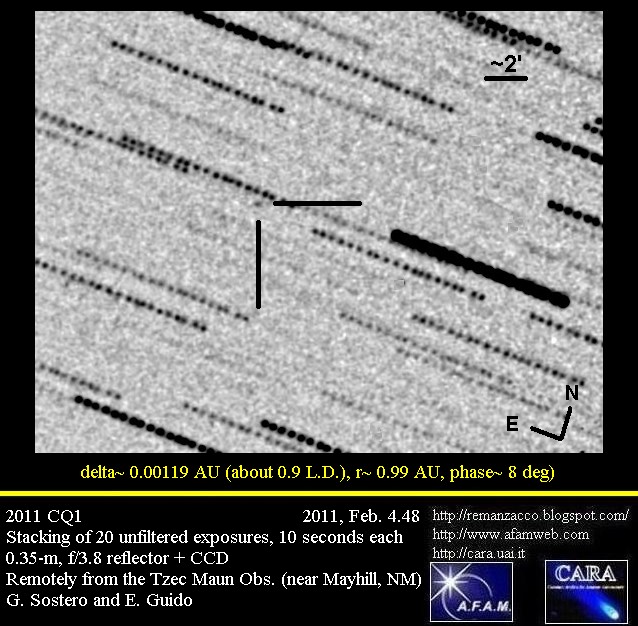
The newly discovered object, officially designated 2011 CQ1, is shown in this image from Tzec Maun Observatory in New Mexico. G. Sostero & E. Guido/Remanzacco Observatory

Trajectory of Asteroid 2011 CQ1 - February 4, 2011, Source: NASA JPL
From Don Yeomans and Paul Chodas at JPL...
Asteroid 2011 CQ1 was discovered by the Catalina Sky Survey on February 4 and made a record close Earth approach 14 hours later on February 4 at 19:39 UT (14:39 EST). It passed to within 0.85 Earth radii (5480 km) of the Earth's surface over a region in the mid-Pacific. This object, only about one meter in diameter, is the closest non-impacting object in our asteroid catalog to date. Prior to the Earth close approach, this object was in a so-called Apollo-class orbit that was mostly outside the Earth's orbit. Following the close approach, the Earth's gravitational attraction modified the object's orbit to an Aten-class orbit where the asteroid spends almost all of its time inside the Earth's orbit.
As is evident from the diagram, the close Earth approach changed the asteroid's flight path by about 60 degrees. Because of their small size, object's of this size are difficult to discover but there is likely to be nearly a billion objects of this size and larger in near-Earth space and one would expect one to strike Earth's atmosphere every few weeks on average. Upon striking the atmosphere, small objects of this size create visually impressive fireball events but only rarely do even a few small fragments reach the ground.
Link: NASA JPL NEO page post ("Very Small Asteroid Makes Close Earth Approach on February 4, 2011")
From the Scientific American post (also space.com article) on Asteroid 2011 CQ1...
The solar system is littered with natural debris—asteroids, comets and pieces of the same that occasionally wind up in the steamrolling path of one of the planets. When a piece of debris encounters the friction of Earth's atmosphere, it flares up as a meteor, or shooting star, and pieces of the object may survive the heat of reentry to reach the surface as meteorites.
Many more objects whiz past Earth without striking the atmosphere, perhaps returning for another pass some years later. Many of those go undetected, especially the small asteroids that are harder to spot with the relatively modest telescopes that keep watch for near-Earth objects.
But sky monitors did spot one small asteroid, called 2011 CQ1, less than a day before it buzzed Earth at the smallest distance ever recorded. On February 4, the meter-size rock flew over the Pacific at an altitude of about 5,500 kilometers—about one-seventieth the distance between Earth and the moon and well below the orbit of some high-flying satellites.
But even though 2011 CQ1 skirted immolation in Earth's atmosphere, it did not escape from the encounter unmolested. Earth's gravity gave the asteroid a good tweak, redirecting its trajectory by about 60 degrees in much the same way that interplanetary spacecraft use the gravity of the planets for course corrections or speed adjustments. "Prior to the Earth close approach, this object was in a so-called Apollo-class orbit that was mostly outside the Earth's orbit," asteroid trackers Don Yeomans and Paul Chodas wrote on the NASA Near-Earth Object Program Web site. "Following the close approach, the Earth's gravitational attraction modified the object's orbit to an Aten-class orbit where the asteroid spends almost all of its time inside the Earth's orbit."
Just what is in store for the tiny asteroid is unclear—faint as 2011 CQ1 is, it was visible only briefly, when it was very close to Earth, and its newly adjusted orbit is not well understood.
Link: Scientific American post ("Record-setting "near miss" of Earth dramatically shifted tiny asteroid's orbit")
New Release: "NASA Hosting Events for Valentine's Night Comet Encounter"

Stardust-NExt. Artist concept of NASA's Stardust-NExT mission, which will fly by comet Tempel 1 on Feb. 14, 2011. Image credit: NASA/JPL-Caltech/LMSS
From the JPL news release (also available, another more general news release) on the Stardust-NExT mission...
NASA will host several live activities for the Stardust-NExT mission's close encounter with comet Tempel 1. The closest approach is expected at approximately 8:37 p.m. PST (11:37 p.m. EST) on Feb. 14, with confirmation received on Earth at about 8:56 p.m. PST (11:56 p.m. EST).
Live coverage of the Tempel 1 encounter will begin at 8:30 p.m. PST on Feb. 14 on NASA Television and the agency's website. The coverage will include live commentary from mission control at NASA's Jet Propulsion Laboratory in Pasadena, Calif., and video from Lockheed Martin Space System's mission support area in Denver.
Live coverage of a news briefing is planned for 10 a.m. PST on Feb. 15. Scheduled participants are:
-- Ed Weiler, NASA associate administrator, Science Mission Directorate, Washington
-- Joe Veverka, Stardust-NExT principal investigator, Cornell University, Ithaca, N.Y.
-- Tim Larson, Stardust-NExT project manager, JPL
-- Don Brownlee, Stardust-NExT co-investigator, University of Washington, Seattle
Mission coverage schedule (all times PST and subject to change):
-- 8:30 to 10 p.m., Feb. 14: Live NASA TV commentary begins from mission control; includes coverage of closest approach and the re-establishment of contact with the spacecraft following the encounter.
-- Midnight to 1:30 a.m., Feb. 15: NASA TV commentary will chronicle the arrival and processing of the first five of 72 close-approach images the team expects to be downlinked after the encounter. The images are expected to include a close-up view of the comet's surface.
-- 10 a.m., Feb. 15: News briefing
-- Starting on Feb. 9, NASA TV will air Stardust-NExT mission animation and other video during its Video File segments. For NASA TV streaming video, scheduling and downlink information, visit: http://www.nasa.gov/ntv.
-- Commentary and the news conference will also be carried live on one of JPL's Ustream channels. During events, viewers can engage in a real-time chat and submit questions to the Stardust-NExT team at: http://www.ustream.tv/user/NASAJPL2.
The public can watch a real-time animation of the Stardust-NExT comet flyby using NASA's new "Eyes on the Solar System" Web tool. JPL created this 3-D environment, which allows people to explore the solar system from their computers. It is available at: http://solarsystem.nasa.gov/eyes.
This flyby of Tempel 1 will give scientists an opportunity to look for changes on the comet's surface since it was visited by NASA's Deep Impact spacecraft in July 2005. Since then, Tempel 1 has completed one orbit of the sun, and scientists are looking forward to monitoring any differences in the comet.
During its 12 years in space, Stardust became the first spacecraft to collect samples of a comet (Wild 2 in 2004), which were delivered to Earth in 2006 for study. The Stardust-NExT mission is managed by JPL for NASA's Science Mission Directorate in Washington. Lockheed Martin Space Systems in Denver built the spacecraft and manages day-to-day mission operations.
A press kit and other detailed information about Stardust-NExT is available at: http://stardustnext.jpl.nasa.gov.
Link: JPL News Release ("NASA Hosting Events for Valentine's Night Comet Encounter")
Link: JPL News Release ("Heading Into the Bonus Round – in Space")
JPL News Release: "NASA's NEOWISE Completes Scan for Asteroids and Comets"

Comets WISE -- A Family Portrait. Image Credit: NASA/JPL-Caltech/UCLA
From the JPL news release (also available is the image description)...
NASA's NEOWISE mission has completed its survey of small bodies, asteroids and comets, in our solar system. The mission's discoveries of previously unknown objects include 20 comets, more than 33,000 asteroids in the main belt between Mars and Jupiter, and 134 near-Earth objects (NEOs). The NEOs are asteroids and comets with orbits that come within 45 million kilometers (28 million miles) of Earth's path around the sun.
NEOWISE is an enhancement of the Wide-field Infrared Survey Explorer, or WISE, mission that launched in December 2009. WISE scanned the entire celestial sky in infrared light about 1.5 times. It captured more than 2.7 million images of objects in space, ranging from faraway galaxies to asteroids and comets close to Earth.
In early October 2010, after completing its prime science mission, the spacecraft ran out of the frozen coolant that keeps its instrumentation cold. However, two of its four infrared cameras remained operational. These two channels were still useful for asteroid hunting, so NASA extended the NEOWISE portion of the WISE mission by four months, with the primary purpose of hunting for more asteroids and comets, and to finish one complete scan of the main asteroid belt.
"Even just one year of observations from the NEOWISE project has significantly increased our catalog of data on NEOs and the other small bodies of the solar systems," said Lindley Johnson, NASA's program executive for the NEO Observation Program.
Now that NEOWISE has successfully completed a full sweep of the main asteroid belt, the WISE spacecraft will go into hibernation mode and remain in polar orbit around Earth, where it could be called back into service in the future.
In addition to discovering new asteroids and comets, NEOWISE also confirmed the presence of objects in the main belt that had already been detected. In just one year, it observed about 153,000 rocky bodies out of approximately 500,000 known objects. Those include the 33,000 that NEOWISE discovered.
NEOWISE also observed known objects closer and farther to us than the main belt, including roughly 2,000 asteroids that orbit along with Jupiter, hundreds of NEOs and more than 100 comets.
These observations will be key to determining the objects' sizes and compositions. Visible-light data alone reveal how much sunlight reflects off an asteroid, whereas infrared data is much more directly related to the object's size. By combining visible and infrared measurements, astronomers also can learn about the compositions of the rocky bodies -- for example, whether they are solid or crumbly. The findings will lead to a much-improved picture of the various asteroid populations.
NEOWISE took longer to survey the whole asteroid belt than WISE took to scan the entire sky because most of the asteroids are moving in the same direction around the sun as the spacecraft moves while it orbits Earth. The spacecraft field of view had to catch up to, and lap, the movement of the asteroids in order to see them all.
"You can think of Earth and the asteroids as racehorses moving along in a track," said Amy Mainzer, the principal investigator of NEOWISE at NASA's Jet Propulsion Laboratory in Pasadena, Calif. "We're moving along together around the sun, but the main belt asteroids are like horses on the outer part of the track. They take longer to orbit than us, so we eventually lap them."
NEOWISE data on the asteroid and comet orbits are catalogued at the NASA-funded International Astronomical Union's Minor Planet Center, a clearinghouse for information about all solar system bodies at the Smithsonian Astrophysical Observatory in Cambridge, Mass. The science team is analyzing the infrared observations now and will publish new findings in the coming months.
When combined with WISE observations, NEOWISE data will aid in the discovery of the closest dim stars, called brown dwarfs. These observations have the potential to reveal a brown dwarf even closer to us than our closest known star, Proxima Centauri, if such an object does exist. Likewise, if there is a hidden gas-giant planet in the outer reaches of our solar system, data from WISE and NEOWISE could detect it.
The first batch of observations from the WISE mission will be available to the public and astronomical community in April.
"WISE has unearthed a mother lode of amazing sources, and we're having a great time figuring out their nature," said Edward (Ned) Wright, the principal investigator of WISE at UCLA.
JPL manages WISE for NASA's Science Mission Directorate at the agency's headquarters in Washington. The mission was competitively selected under NASA's Explorers Program, which NASA's Goddard Space Flight Center in Greenbelt, Md., manages. The Space Dynamics Laboratory in Logan, Utah, built the science instrument, and Ball Aerospace & Technologies Corp. of Boulder, Colo., built the spacecraft. Science operations and data processing take place at the Infrared Processing and Analysis Center at the California Institute of Technology in Pasadena. JPL manages NEOWISE for NASA's Planetary Sciences Division. The mission's data processing also takes place at the Infrared Processing and Analysis Center.
Link: JPL News Release ("NASA's NEOWISE Completes Scan for Asteroids and Comets")
02 February 2011
The Onion (Fake): "Republicans Vote To Repeal Obama-Backed Bill That Would Destroy Asteroid Headed For Earth"

From The Onion (a fake new story)...
WASHINGTON—In a strong rebuke of President Obama and his domestic agenda, all 242 House Republicans voted Wednesday to repeal the Asteroid Destruction and American Preservation Act, which was signed into law last year to destroy the immense asteroid currently hurtling toward Earth.
The $440 billion legislation, which would send a dozen high-thrust plasma impactor probes to shatter the massive asteroid before it strikes the planet, would affect more than 300 million Americans and is strongly opposed by the GOP.
"The voters sent us to Washington to stand up for individual liberty, not big government," Rep. Steve King (R-IA) said at a press conference. "Obama's plan would take away citizens' fundamental freedoms, forcing each of us into hastily built concrete bunkers and empowering the federal government to ration our access to food, water, and potassium iodide tablets while underground."
"We believe that the decisions of how to deal with the massive asteroid are best left to the individual," King added.
Repealing the act, which opponents have branded 'Obamastroid,' has been the cornerstone of the GOP agenda since the law's passage last August. Throughout the 2010 elections, Republican candidates claimed that the Democrats' plan to smash the space rock and shield citizens from its fragments was "a classic example of the federal government needlessly interfering in the lives of everyday Americans."
"This law is a job killer," said Rep. Virginia Foxx (R-NC), who argued the tax increases required to save the human species from annihilation would impose unbearably high costs on businesses. "If we sit back and do nothing, Obamastroid will result in hundreds of thousands of lost jobs, which we simply can't afford in this economy."
"And consider how much money this program will add to our already bloated deficit," Foxx continued. "Is this the legacy we want to leave our children?"
Many GOP members have also criticized the legislation for what they consider pork-barrel spending, claiming the act includes billions in "giveaways" to NASA, nonperishable food manufacturers, and pharmaceutical companies contracted to produce mass volumes of vitamin D supplements in the likely event that dust from the asteroid's impact blots out the sun for a decade.
In an effort to counter Republicans' claims, Democrats have asserted that the long-term benefits of preventing the United States from being incinerated by an explosion several billion times more powerful than the Hiroshima bomb would far outweigh the initial monetary outlay.
In support of their position, Democrats have pointed to estimates from the nonpartisan Congressional Budget Office that show repealing the law could result in a loss of up to $14 trillion in the nation's GDP.
"I will be the first to admit this is not a perfect bill, by any means," said Rep. Elijah Cummings (D-MD), who has argued that the measure does not go far enough in deflecting the ensuing debris that will rain down on Earth once the asteroid has been destroyed. "But it is absolutely a bill that each and every American needs now if we want to move forward as a country."
According to political pundits, the showdown over whether to let the asteroid blast a 150-mile-wide, 20-mile-deep crater in the Earth's crust represents a potential turning point for the nation, and could completely reshape the American political landscape for many centuries to come.
"If efforts to destroy the asteroid are successfully overturned, then there will be major ramifications for both Obama and his Republican opposition, as well as the American populace at large," political scientist Alan Abramowitz said on Face The Nation Sunday. "This could have a huge impact come 2012."
With repeal rhetoric reaching a crescendo, the president used his weekly radio address Saturday to state his case for destroying the one-trillion-ton asteroid before it barrels into Earth at 60,000 miles per hour.
"I am more than willing to work with my Republican colleagues to improve the Asteroid Destruction Act," Obama said. "But let me be clear: Repeal is not an option."
"While I recognize that intelligent minds may disagree on this issue, I believe we have an obligation to prevent our citizens from having their flesh seared off in a global firestorm that transforms our planet into a broiling molten wasteland," Obama added. "I think Americans deserve better."
Link: The Onion ("Republicans Vote To Repeal Obama-Backed Bill That Would Destroy Asteroid Headed For Earth")
Subscribe to:
Posts (Atom)