
From AIAA news digest:
Russian Call For Asteroid Mission At Odds With NASA Statistics.
The AP (12/31, Isachenkov), in continuing coverage, reports, "Russia's space agency chief said Wednesday a spacecraft may be dispatched to knock a large asteroid off course and reduce the chances of earth impact, even though U.S. scientists say such a scenario is unlikely." Anatoly Perminov of Roscosmos said the agency would be meeting to discuss a mission to deflect Apophis from Earth, even though NASA recently lowered the odds of an impact in 2036 to one chance in 250,000. Perminov also stated Russia "might eventually invite" other space agencies to help with the effort. Don Yeomans, head of NASA's Near-Earth Object (NEO) Program, said improved calculations would "almost certainly remove" a chance of a hit, although he said he was "encouraged that the Russian science community is willing to study the various deflection options." Boris Shustov, the director of the Institute of Astronomy under the Russian Academy of Sciences, "hailed" Perminov's announcement "as a signal that officials had come to recognize the danger posed by asteroids."
The New York Times (12/31, A6, Barry) cites Apollo astronaut Russell Schweickart, chairman of the B612 Foundation which "promotes" such efforts. Schweickart also "hailed much of the proposal and said Mr. Perminov was the most influential official ever to articulate a coordinated deflection plan. But he objected to using Apophis to test new deflection methods, saying there was more risk if something went wrong." The USA Today (12/30, Stanglin) "On Demand" blog noted, Russia "is particularly sensitive to the threat from outer space because of a meteorite that struck a remote region of Siberia in 1908."
NBC News (12/31) reports on its website that "space analyst James Oberg agreed that the asteroid impact threat merited more international attention, but he worried that the Russian statements were 'way overblown' and might be counterproductive." Even though Oberg said such an endeavor "must be undertaken in a world consensus mode," he thought Russia "really has nothing to contribute to such an effort aside from cheap boosters - and all of them too small for any serious asteroid deflection effort."
According to Space.com (12/30, Malik), an attempt to deflect Apophis "could actually make matters worse, experts say." Paul Chodas, a member of the NEO Program office, said, "You have the potential of increasing the impact probability with failures in the mission." However, Russian officials "apparently consider Apophis a significant threat to life on Earth despite the low odds of an impact." Meanwhile, Voice of America (12/30, Babb) reports Chodas "praised Russia for suggesting international collaboration on how to avoid such a collision." However, Chodas "says that other asteroids, including those that have not yet been discovered, could pose more of a risk and call for more research."
AFP (12/30), UK's Daily Telegraph (12/31), Canada's Toronto Star (12/31, Kelly), UK's The Guardian (12/31, Adam), and the Wired (12/30, Hodge) "Danger Room" blog also covered the story.
31 December 2009


30 December 2009
Russian Asteroid Deflection Mission Comments
From the article:
Roscosmos will soon consider a project to prevent a large asteroid from colliding with Earth after 2030, the head of Russia’s space agency said on Wednesday.
“A scientist recently told me an interesting thing about the path [of an asteroid] constantly nearing Earth… He has calculated that it will surely collide with Earth in the 2030 s,” Anatoly Perminov said during an interview with the Voice of Russia radio.
He referred to Apophis, an asteroid that he said was almost three times as large as the Tunguska meteorite.
On June 30, 1908, an explosion equivalent to between 5 and 30 megatons of TNT occurred near the Podkamennaya Tunguska River in a remote region of Russia’s Siberia. The Tunguska blast flattened 80 million trees, destroying an area of around 2,150 sq km (830 sq miles).
Perminov said Russia was not planning to destroy the asteroid.
“No nuclear explosions [will be carried out], everything [will be done] on the basis of the laws of physics,” he said.
The Russian space official also said after having considered the project, Russia could invite experts from Europe, the United States and China to join it.
“People’s lives are at stake. We should pay several hundred million dollars and design a system that would prevent a collision, rather than sit and wait for it to happen and kill hundreds of thousands of people,” Perminov said.
Though Apophis is currently considered the largest threat to our planet, NASA scientists published in October an update of its orbit indicating “a significantly reduced likelihood of a hazardous encounter with Earth in 2036.”
Source: RIA Novosti
Link: Article
Roscosmos will soon consider a project to prevent a large asteroid from colliding with Earth after 2030, the head of Russia’s space agency said on Wednesday.
“A scientist recently told me an interesting thing about the path [of an asteroid] constantly nearing Earth… He has calculated that it will surely collide with Earth in the 2030 s,” Anatoly Perminov said during an interview with the Voice of Russia radio.
He referred to Apophis, an asteroid that he said was almost three times as large as the Tunguska meteorite.
On June 30, 1908, an explosion equivalent to between 5 and 30 megatons of TNT occurred near the Podkamennaya Tunguska River in a remote region of Russia’s Siberia. The Tunguska blast flattened 80 million trees, destroying an area of around 2,150 sq km (830 sq miles).
Perminov said Russia was not planning to destroy the asteroid.
“No nuclear explosions [will be carried out], everything [will be done] on the basis of the laws of physics,” he said.
The Russian space official also said after having considered the project, Russia could invite experts from Europe, the United States and China to join it.
“People’s lives are at stake. We should pay several hundred million dollars and design a system that would prevent a collision, rather than sit and wait for it to happen and kill hundreds of thousands of people,” Perminov said.
Though Apophis is currently considered the largest threat to our planet, NASA scientists published in October an update of its orbit indicating “a significantly reduced likelihood of a hazardous encounter with Earth in 2036.”
Source: RIA Novosti
Link: Article
23 November 2009
Article on Human NEO Mission (Fallout from Flexible Path)
Selections from the article:
Call it Operation: Plymouth Rock. A plan to send a crew of astronauts to an asteroid is gaining momentum, both within NASA and industry circles.
Not only would the deep space sojourn shake out hardware, it would also build confidence in long-duration stints at the moon and Mars. At the same time, the trek would sharpen skills to deal with a future space rock found on a collision course with Earth.
In Lockheed Martin briefing charts, the mission has been dubbed "Plymouth Rock – An Early Human Asteroid Mission Using Orion." Lockheed is the builder of NASA's Orion spacecraft, the capsule-based replacement for the space shuttle.
Study teams are now readying high-level briefings for NASA leaders - perhaps as early as this week - on a pilgrimage to an asteroid, along with appraisals of anchoring large, astronaut-enabled telescopes far from Earth, a human precursor mission to the vicinity of Mars, as well as an initiative to power-beam energy from space to Earth.
The briefings have been spurred in response to the recent Review of U.S. Human Spaceflight Plans Committee and the option of a "Flexible Path" to human exploration beyond low-Earth orbit.
The merits of a human mission to a Near Earth Object (NEO) were detailed here Nov. 18 during a two-day meeting of the Small Bodies Assessment Group, SBAG for short.
SBAG was established by NASA in 2008 to identify scientific priorities and opportunities for the exploration of asteroids, comets, interplanetary dust, small satellites, and Trans-Neptunian Objects. The group also provides scientific input on the utility of asteroids and comets in support of human space activities.
The new studies are viewed as an iterative process - to be weighed both by NASA and the White House, said Paul Abell, a research scientist at the Planetary Science Institute detailed to the space agency's Johnson Space Center in Houston, Texas and working in the Astromaterials Research and Exploration Science Directorate. "It's going to take a bit of time. I don't think there's going to be a quick decision."
How the White House will react to a human trek to an asteroid is beyond anybody's crystal ball. However, undertaking the effort has garnered the attention of Lockheed Martin - builder of the space shuttle replacement - the Orion spacecraft.
The Plymouth Rock mission study began a couple years ago, said Josh Hopkins, in the advanced programs for human space flight division at Lockheed Martin Space Systems Company in Denver, Colo.
Initial looks at the NEO venture involve the coupling of two Orion spacecraft.
In this situation, a two-person Orion would link up with an unpiloted sister craft that's loaded with extra fuel, food, water, and oxygen. It would be tossed into orbit - as well as an Earth departure stage - by NASA's planned Ares V heavy-lift booster
"Plan for Human Mission to Asteroid Gains Speed"
Space.com
Leonard David
23 November 2009
Link: Space.com article
Call it Operation: Plymouth Rock. A plan to send a crew of astronauts to an asteroid is gaining momentum, both within NASA and industry circles.
Not only would the deep space sojourn shake out hardware, it would also build confidence in long-duration stints at the moon and Mars. At the same time, the trek would sharpen skills to deal with a future space rock found on a collision course with Earth.
In Lockheed Martin briefing charts, the mission has been dubbed "Plymouth Rock – An Early Human Asteroid Mission Using Orion." Lockheed is the builder of NASA's Orion spacecraft, the capsule-based replacement for the space shuttle.
Study teams are now readying high-level briefings for NASA leaders - perhaps as early as this week - on a pilgrimage to an asteroid, along with appraisals of anchoring large, astronaut-enabled telescopes far from Earth, a human precursor mission to the vicinity of Mars, as well as an initiative to power-beam energy from space to Earth.
The briefings have been spurred in response to the recent Review of U.S. Human Spaceflight Plans Committee and the option of a "Flexible Path" to human exploration beyond low-Earth orbit.
The merits of a human mission to a Near Earth Object (NEO) were detailed here Nov. 18 during a two-day meeting of the Small Bodies Assessment Group, SBAG for short.
SBAG was established by NASA in 2008 to identify scientific priorities and opportunities for the exploration of asteroids, comets, interplanetary dust, small satellites, and Trans-Neptunian Objects. The group also provides scientific input on the utility of asteroids and comets in support of human space activities.
The new studies are viewed as an iterative process - to be weighed both by NASA and the White House, said Paul Abell, a research scientist at the Planetary Science Institute detailed to the space agency's Johnson Space Center in Houston, Texas and working in the Astromaterials Research and Exploration Science Directorate. "It's going to take a bit of time. I don't think there's going to be a quick decision."
How the White House will react to a human trek to an asteroid is beyond anybody's crystal ball. However, undertaking the effort has garnered the attention of Lockheed Martin - builder of the space shuttle replacement - the Orion spacecraft.
The Plymouth Rock mission study began a couple years ago, said Josh Hopkins, in the advanced programs for human space flight division at Lockheed Martin Space Systems Company in Denver, Colo.
Initial looks at the NEO venture involve the coupling of two Orion spacecraft.
In this situation, a two-person Orion would link up with an unpiloted sister craft that's loaded with extra fuel, food, water, and oxygen. It would be tossed into orbit - as well as an Earth departure stage - by NASA's planned Ares V heavy-lift booster
"Plan for Human Mission to Asteroid Gains Speed"
Space.com
Leonard David
23 November 2009
Link: Space.com article
29 October 2009
Article: "Huge Explosion Was Biggest Space Rock to Strike Earth Since 1994"
Huge Explosion Was Biggest Space Rock to Strike Earth Since 1994
Leonard David
Space.com
29 October 2009
A space rock explosion earlier this month over an island region of Indonesia is now being viewed as perhaps the biggest object to tangle with the Earth in more than a decade.
On Oct. 8, reports from Indonesia told of a loud air blast around 11 a.m. local time. One report indicated a bright fireball, accompanied by an explosion and lingering dust cloud, as the origin of the air blast.
According to experts at the NASA/JPL Near-Earth Object Program Office in Pasadena, Calif. – Don Yeomans, Paul Chodas, Steve Chesley – the blast is thought to be due to the atmospheric entry of an asteroid more than 30 feet (10 meters) in diameter. Due to atmospheric pressure, the object is thought to have detonated in the atmosphere, yielding an energy release of about 50 kilotons (the equivalent of 100,000 pounds of TNT explosives).
"My understanding is that this may have been the largest object to strike the Earth since the fireball near the Marshall Islands in the South Pacific on February 1, 1994," said Clark Chapman, a noted specialist in asteroids and a planetary scientist at the Southwest Research Institute (SwRI) in Boulder, Colo.
"Although the Indonesian object was large and the resulting atmospheric explosion may have been the equivalent of several Hiroshima bombs, it is not unexpected for our planet to be hit every decade or so by such an object," Chapman told SPACE.com.
Preliminary investigation
A preliminary look at the incident has been performed by Canadian researchers Peter Brown and graduate student Elizabeth Silber, of the Meteor Infrasound group in the department of Physics and Astronomy at the University of Western Ontario in London, Ontario.
The researchers made a detailed examination of all International Monitoring System infrasound stations of the Comprehensive Nuclear-Test-Ban Treaty Organization (CTBTO). An initial look found that a total of 11 stations showed probable signals from a large explosion.
Based on their scrutiny of the infrasound records, the Canadian research team reported that a large (40-50 kilotons of TNT) bolide detonation occurred near the coastal city of Bone in South Sulawesi, Indonesia. The infrasonic geolocation is not precise enough to determine if the bolide was over water or land, but it was relatively near the coast, the team reported.
Follow-on observations from other instruments or ground recovery efforts, the Canadian team added, would be very valuable in further refining this unique event. Their analysis corresponds to an object some 16-33 feet (5-10 meters) in diameter. Based on the earlier work by Brown, such objects are expected to impact the Earth on average every two to 12 years.
"We are trying to coordinate with some local scientists to secure more local data, but that will likely take several weeks," Brown told SPACE.com.
Brown said a YouTube video that was aired a few days after the event convinced them it was a bolide.
"Had this happened over the ocean we would only have known that there had been a big explosion...we would presume it was a fireball, but it could be anything producing a large impulsive shock in the atmosphere," Brown said.
More data is expected from U.S. military space assets that likely detected the event. From their vantage point in space, multiple sensor systems would have seen the huge explosion and there surely is a rich dataset of measurements to be plumbed relating to the detonation.
Wall of secrecy
Why wasn't this asteroid observed before it hit?
SwRI's Chapman said he was not aware that the object was seen before it plowed into Earth's atmosphere.
"The body was large enough that some of the current Spaceguard Survey telescopes might have detected it a couple of days before it hit, were it coming from the night sky. But it struck during daytime and probably could not have been seen by those telescopes," Chapman explained.
A second question is whether it was detected by military satellites that monitor bright flashes in the Earth's atmosphere for defense and security purposes.
"Almost certainly it was detected and presumably immediately identified as an explosion of a large meteoroid rather than, say, an explosion of a human-made device in the atmosphere," Chapman figures. "But these satellites are secret and, in the past, the establishments controlling them have delayed releasing the data, for weeks or months."
Earlier this year, Chapman added, a change in previous policy led the U.S. military to withhold the data from the public.
"Scientists hope that they will reverse that policy. This event will demonstrate whether the wall of secrecy is coming down again, or not," Chapman noted. "Evidently, because of the passage of weeks since the event, there has been no decision to release the data promptly."
Link: Space.com Article
Leonard David
Space.com
29 October 2009
A space rock explosion earlier this month over an island region of Indonesia is now being viewed as perhaps the biggest object to tangle with the Earth in more than a decade.
On Oct. 8, reports from Indonesia told of a loud air blast around 11 a.m. local time. One report indicated a bright fireball, accompanied by an explosion and lingering dust cloud, as the origin of the air blast.
According to experts at the NASA/JPL Near-Earth Object Program Office in Pasadena, Calif. – Don Yeomans, Paul Chodas, Steve Chesley – the blast is thought to be due to the atmospheric entry of an asteroid more than 30 feet (10 meters) in diameter. Due to atmospheric pressure, the object is thought to have detonated in the atmosphere, yielding an energy release of about 50 kilotons (the equivalent of 100,000 pounds of TNT explosives).
"My understanding is that this may have been the largest object to strike the Earth since the fireball near the Marshall Islands in the South Pacific on February 1, 1994," said Clark Chapman, a noted specialist in asteroids and a planetary scientist at the Southwest Research Institute (SwRI) in Boulder, Colo.
"Although the Indonesian object was large and the resulting atmospheric explosion may have been the equivalent of several Hiroshima bombs, it is not unexpected for our planet to be hit every decade or so by such an object," Chapman told SPACE.com.
Preliminary investigation
A preliminary look at the incident has been performed by Canadian researchers Peter Brown and graduate student Elizabeth Silber, of the Meteor Infrasound group in the department of Physics and Astronomy at the University of Western Ontario in London, Ontario.
The researchers made a detailed examination of all International Monitoring System infrasound stations of the Comprehensive Nuclear-Test-Ban Treaty Organization (CTBTO). An initial look found that a total of 11 stations showed probable signals from a large explosion.
Based on their scrutiny of the infrasound records, the Canadian research team reported that a large (40-50 kilotons of TNT) bolide detonation occurred near the coastal city of Bone in South Sulawesi, Indonesia. The infrasonic geolocation is not precise enough to determine if the bolide was over water or land, but it was relatively near the coast, the team reported.
Follow-on observations from other instruments or ground recovery efforts, the Canadian team added, would be very valuable in further refining this unique event. Their analysis corresponds to an object some 16-33 feet (5-10 meters) in diameter. Based on the earlier work by Brown, such objects are expected to impact the Earth on average every two to 12 years.
"We are trying to coordinate with some local scientists to secure more local data, but that will likely take several weeks," Brown told SPACE.com.
Brown said a YouTube video that was aired a few days after the event convinced them it was a bolide.
"Had this happened over the ocean we would only have known that there had been a big explosion...we would presume it was a fireball, but it could be anything producing a large impulsive shock in the atmosphere," Brown said.
More data is expected from U.S. military space assets that likely detected the event. From their vantage point in space, multiple sensor systems would have seen the huge explosion and there surely is a rich dataset of measurements to be plumbed relating to the detonation.
Wall of secrecy
Why wasn't this asteroid observed before it hit?
SwRI's Chapman said he was not aware that the object was seen before it plowed into Earth's atmosphere.
"The body was large enough that some of the current Spaceguard Survey telescopes might have detected it a couple of days before it hit, were it coming from the night sky. But it struck during daytime and probably could not have been seen by those telescopes," Chapman explained.
A second question is whether it was detected by military satellites that monitor bright flashes in the Earth's atmosphere for defense and security purposes.
"Almost certainly it was detected and presumably immediately identified as an explosion of a large meteoroid rather than, say, an explosion of a human-made device in the atmosphere," Chapman figures. "But these satellites are secret and, in the past, the establishments controlling them have delayed releasing the data, for weeks or months."
Earlier this year, Chapman added, a change in previous policy led the U.S. military to withhold the data from the public.
"Scientists hope that they will reverse that policy. This event will demonstrate whether the wall of secrecy is coming down again, or not," Chapman noted. "Evidently, because of the passage of weeks since the event, there has been no decision to release the data promptly."
Link: Space.com Article
26 October 2009
HOAX: Meteorite-like object falls in Latvia
NOTE: INITIAL STORY IS A HOAX
From the AP article...
Latvian experts say meteorite crater was hoax
RIGA, Latvia – Scientists investigating a large crater initially believed to have been caused by a meteorite said a closer analysis Monday revealed it was a hoax.
Experts in the Baltic country rushed to the site after reports that a metorite-like object had crashed late Sunday in the Mazsalaca region near the Estonian border.
"This is not a real crater. It is artificial," Uldis Nulle, a scientist at the Latvian Environment, Geology and Meteorology Center, said after inspecting the site on Monday.
Earlier Uldis had said his first impression late Sunday was that the 27-foot (nine-meter) wide and nine foot (three-meter) deep crater had been caused by a meteorite. He said there was smoke coming out of the hole when he arrived.
Uldis and other experts who examined the hole in daylight on Monday said it was too tidy to have been caused by a meteorite.
"It's artificial, dug by shovel," said Girts Stinkulis, a geologist at the University of Latvia.
Dainis Ozols, a nature conservationist, said he believes someone dug the hole and tried to make it look like a meteorite crater by burning some pyrotechnic compound at the bottom. He added he would analyze some samples taken from the site.
Sigita Pildava, a spokeswoman for the State Police, said it wasn't immediately clear whether police would open an investigation into the hoax.
Inga Vetere of the Fire and Rescue Service said they received a call about the alleged meteorite on Sunday evening from an eyewitness. She said a military unit was dispatched to the site and found that radiation levels were normal.
Experts outside Latvia said it would be unusual for such a large meteorite to hit the Earth. The planet is constantly bombarded with objects from outer space, but most burn up in the atmosphere and never reach the surface.
In 2007, a meteorite crashed near Lake Titicaca in Peru, causing a crater about 40 feet (12 meters) wide and 15 feet (five meters) deep.
Asta Pellinen-Wannberg, a meteorite expert at the Swedish Institute of Space Research, said she didn't know the details of the Latvian incident, but that a rock would have to be at least three feet (one meter) in diameter to create a hole that size.
Henning Haack, a lecturer at Copenhagen University's Geological Museum, said when it comes to alleged meteorite crashes, "there always is a pretty large margin of error."
Link: AP Article
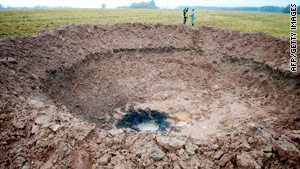
Meteorite-like object falls in Latvia
October 26, 2009 -- Updated 1308 GMT (2108 HKT)
(CNN) -- A meteorite-like object has created a crater after landing near a farm in northern Latvia, the nation's official news agency reported.
The object fell Sunday in Mazsalaca, leaving a hole of about 65 feet (20 meters) wide and 32 feet (10 meters) deep, Latvian emergency officials told the LETA news agency.
A fire was reported in the grassy area where it landed, but there were no known injuries, LETA said.
Scientists and armed forces from the northern European nation will inspect the crater and conduct an investigation.
No further information was immediately available.
Link: CNN article
From the AP article...
Latvian experts say meteorite crater was hoax
RIGA, Latvia – Scientists investigating a large crater initially believed to have been caused by a meteorite said a closer analysis Monday revealed it was a hoax.
Experts in the Baltic country rushed to the site after reports that a metorite-like object had crashed late Sunday in the Mazsalaca region near the Estonian border.
"This is not a real crater. It is artificial," Uldis Nulle, a scientist at the Latvian Environment, Geology and Meteorology Center, said after inspecting the site on Monday.
Earlier Uldis had said his first impression late Sunday was that the 27-foot (nine-meter) wide and nine foot (three-meter) deep crater had been caused by a meteorite. He said there was smoke coming out of the hole when he arrived.
Uldis and other experts who examined the hole in daylight on Monday said it was too tidy to have been caused by a meteorite.
"It's artificial, dug by shovel," said Girts Stinkulis, a geologist at the University of Latvia.
Dainis Ozols, a nature conservationist, said he believes someone dug the hole and tried to make it look like a meteorite crater by burning some pyrotechnic compound at the bottom. He added he would analyze some samples taken from the site.
Sigita Pildava, a spokeswoman for the State Police, said it wasn't immediately clear whether police would open an investigation into the hoax.
Inga Vetere of the Fire and Rescue Service said they received a call about the alleged meteorite on Sunday evening from an eyewitness. She said a military unit was dispatched to the site and found that radiation levels were normal.
Experts outside Latvia said it would be unusual for such a large meteorite to hit the Earth. The planet is constantly bombarded with objects from outer space, but most burn up in the atmosphere and never reach the surface.
In 2007, a meteorite crashed near Lake Titicaca in Peru, causing a crater about 40 feet (12 meters) wide and 15 feet (five meters) deep.
Asta Pellinen-Wannberg, a meteorite expert at the Swedish Institute of Space Research, said she didn't know the details of the Latvian incident, but that a rock would have to be at least three feet (one meter) in diameter to create a hole that size.
Henning Haack, a lecturer at Copenhagen University's Geological Museum, said when it comes to alleged meteorite crashes, "there always is a pretty large margin of error."
Link: AP Article
Meteorite-like object falls in Latvia
October 26, 2009 -- Updated 1308 GMT (2108 HKT)
(CNN) -- A meteorite-like object has created a crater after landing near a farm in northern Latvia, the nation's official news agency reported.
The object fell Sunday in Mazsalaca, leaving a hole of about 65 feet (20 meters) wide and 32 feet (10 meters) deep, Latvian emergency officials told the LETA news agency.
A fire was reported in the grassy area where it landed, but there were no known injuries, LETA said.
Scientists and armed forces from the northern European nation will inspect the crater and conduct an investigation.
No further information was immediately available.
Link: CNN article
24 October 2009
Asteroid Impactor Reported over Indonesia
From JPL:
Asteroid Impactor Reported over Indonesia
Don Yeomans, Paul Chodas, Steve Chesley
NASA/JPL Near-Earth Object Program Office
October 23, 2008
On October 8, 2009 about 03:00 Greenwich time, an atmospheric fireball blast was observed and recorded over an island region of Indonesia. The blast is thought to be due to the atmospheric entry of a small asteroid about 10 meters in diameter that, due to atmospheric pressure, detonated in the atmosphere with an energy of about 50 kilotons (the equivalent of 50,000 pounds of TNT explosives).
The blast was recorded visually and reported upon by local media representatives. See the YouTube video at:
http://www.youtube.com/watch?v=yeQBzTkJNhs&videos=jkRJgbXY-90
A report from Elizabeth Silber and Peter Brown at the University of Western Ontario indicates that several international very-long wavelength infrasound detectors recorded the blast and fixed the position near the coastal city of Bone in South Sulawesi, island of Sulewesi. They note that the blast was in the 10 to 50 kT range with the higher end of this range being more likely.
Assuming an estimated size of about 5-10 meters in diameter, we would expect a fireball event of this magnitude about once every 2 to 12 years on average. As a rule, the most common types of stony asteroids would not be expected to cause ground damage unless their diameters were about 25 meters in diameter or larger.
Link: JPL NEO News Item
Link: YouTube Video (Benda Mirip Meteor Jatuh di Bone, Sulawesi Utara -- MAPer1ck9 Files)
08 October 2009
Apophis impact probability of Earth encounter on April 13, 2036, dropped from one-in-45,000 to about four-in-a million
From the JPL News Article:
Using updated information, NASA scientists have recalculated the path of a large asteroid. The refined path indicates a significantly reduced likelihood of a hazardous encounter with Earth in 2036.
The Apophis asteroid is approximately the size of two-and-a-half football fields. The new data were documented by near-Earth object scientists Steve Chesley and Paul Chodas at NASA's Jet Propulsion Laboratory in Pasadena, Calif. They will present their updated findings at a meeting of the American Astronomical Society's Division for Planetary Sciences in Puerto Rico on Oct. 8.
"Apophis has been one of those celestial bodies that has captured the public's interest since it was discovered in 2004," said Chesley. "Updated computational techniques and newly available data indicate the probability of an Earth encounter on April 13, 2036, for Apophis has dropped from one-in-45,000 to about four-in-a million."
A majority of the data that enabled the updated orbit of Apophis came from observations Dave Tholen and collaborators at the University of Hawaii's Institute for Astronomy in Manoa made. Tholen pored over hundreds of previously unreleased images of the night sky made with the University of Hawaii's 2.2-meter (88-inch) telescope, located near the summit of Mauna Kea.
Tholen made improved measurements of the asteroid's position in the images, enabling him to provide Chesley and Chodas with new data sets more precise than previous measures for Apophis. Measurements from the Steward Observatory's 2.3 meter (90-inch) Bok telescope on Kitt Peak in Arizona and the Arecibo Observatory on the island of Puerto Rico also were used in Chesley's calculations.
The information provided a more accurate glimpse of Apophis' orbit well into the latter part of this century. Among the findings is another close encounter by the asteroid with Earth in 2068 with chance of impact currently at approximately three-in-a-million. As with earlier orbital estimates where Earth impacts in 2029 and 2036 could not initially be ruled out due to the need for additional data, it is expected that the 2068 encounter will diminish in probability as more information about Apophis is acquired.
Initially, Apophis was thought to have a 2.7 percent chance of impacting Earth in 2029. Additional observations of the asteroid ruled out any possibility of an impact in 2029. However, the asteroid is expected to make a record-setting -- but harmless -- close approach to Earth on Friday, April 13, 2029, when it comes no closer than 29,450 kilometers (18,300 miles) above Earth's surface.
"The refined orbital determination further reinforces that Apophis is an asteroid we can look to as an opportunity for exciting science and not something that should be feared," said Don Yeomans, manager of the Near-Earth Object Program Office at JPL. "The public can follow along as we continue to study Apophis and other near-Earth objects by visiting us on our AsteroidWatch Web site and by following us on the @AsteroidWatch Twitter feed."
The science of predicting asteroid orbits is based on a physical model of the solar system which includes the gravitational influence of the sun, moon, other planets and the three largest asteroids.
NASA detects and tracks asteroids and comets passing close to Earth using both ground and space-based telescopes. The Near-Earth Object Observations Program, commonly called "Spaceguard," discovers these objects, characterizes a subset of them and plots their orbits to determine if any could be potentially hazardous to our planet.
JPL manages the Near-Earth Object Program Office for NASA's Science Mission Directorate in Washington. JPL is a division of the California Institute of Technology in Pasadena. Cornell University, Ithaca, N.Y., operates the Arecibo Observatory under a cooperative agreement with the National Science Foundation in Arlington, Va.
"NASA Refines Asteroid Apophis' Path Toward Earth"
07 October 2009
Link: NASA JPL News Release
Using updated information, NASA scientists have recalculated the path of a large asteroid. The refined path indicates a significantly reduced likelihood of a hazardous encounter with Earth in 2036.
The Apophis asteroid is approximately the size of two-and-a-half football fields. The new data were documented by near-Earth object scientists Steve Chesley and Paul Chodas at NASA's Jet Propulsion Laboratory in Pasadena, Calif. They will present their updated findings at a meeting of the American Astronomical Society's Division for Planetary Sciences in Puerto Rico on Oct. 8.
"Apophis has been one of those celestial bodies that has captured the public's interest since it was discovered in 2004," said Chesley. "Updated computational techniques and newly available data indicate the probability of an Earth encounter on April 13, 2036, for Apophis has dropped from one-in-45,000 to about four-in-a million."
A majority of the data that enabled the updated orbit of Apophis came from observations Dave Tholen and collaborators at the University of Hawaii's Institute for Astronomy in Manoa made. Tholen pored over hundreds of previously unreleased images of the night sky made with the University of Hawaii's 2.2-meter (88-inch) telescope, located near the summit of Mauna Kea.
Tholen made improved measurements of the asteroid's position in the images, enabling him to provide Chesley and Chodas with new data sets more precise than previous measures for Apophis. Measurements from the Steward Observatory's 2.3 meter (90-inch) Bok telescope on Kitt Peak in Arizona and the Arecibo Observatory on the island of Puerto Rico also were used in Chesley's calculations.
The information provided a more accurate glimpse of Apophis' orbit well into the latter part of this century. Among the findings is another close encounter by the asteroid with Earth in 2068 with chance of impact currently at approximately three-in-a-million. As with earlier orbital estimates where Earth impacts in 2029 and 2036 could not initially be ruled out due to the need for additional data, it is expected that the 2068 encounter will diminish in probability as more information about Apophis is acquired.
Initially, Apophis was thought to have a 2.7 percent chance of impacting Earth in 2029. Additional observations of the asteroid ruled out any possibility of an impact in 2029. However, the asteroid is expected to make a record-setting -- but harmless -- close approach to Earth on Friday, April 13, 2029, when it comes no closer than 29,450 kilometers (18,300 miles) above Earth's surface.
"The refined orbital determination further reinforces that Apophis is an asteroid we can look to as an opportunity for exciting science and not something that should be feared," said Don Yeomans, manager of the Near-Earth Object Program Office at JPL. "The public can follow along as we continue to study Apophis and other near-Earth objects by visiting us on our AsteroidWatch Web site and by following us on the @AsteroidWatch Twitter feed."
The science of predicting asteroid orbits is based on a physical model of the solar system which includes the gravitational influence of the sun, moon, other planets and the three largest asteroids.
NASA detects and tracks asteroids and comets passing close to Earth using both ground and space-based telescopes. The Near-Earth Object Observations Program, commonly called "Spaceguard," discovers these objects, characterizes a subset of them and plots their orbits to determine if any could be potentially hazardous to our planet.
JPL manages the Near-Earth Object Program Office for NASA's Science Mission Directorate in Washington. JPL is a division of the California Institute of Technology in Pasadena. Cornell University, Ithaca, N.Y., operates the Arecibo Observatory under a cooperative agreement with the National Science Foundation in Arlington, Va.
"NASA Refines Asteroid Apophis' Path Toward Earth"
07 October 2009
Link: NASA JPL News Release
01 October 2009
Article: 'Meet the Asteroid Hunters"
 No Pebble Unturned: Astronomers and students from the University of Khartoum form a line half a mile wide to comb the Nubian Desert for tiny fragments of a rare asteroid. Peter Jenniskens/NASA Ames Research Center/SETI
 Meet the Asteroid Hunters: A network of space buffs is learning to track asteroids more accurately than ever to predict exactly when and where the next killer meteorite will strike
Gregory Mone
Popular Science
30 September 2009
On October 7, 2008,shortly before dawn in northern Sudan, a trucker named Omar Fadul el Mula was praying at a remote teahouse in the Nubian Desert when a bright flash lit up the landscape. It was as if the world had switched from night to day. He sprung to his feet, ran around the small building, and saw a huge trail of dust and debris stretched high in the sky.
A rush of percussive blasts followed the display, prompting some people in the region to run inside and hide, while others watched in awe. Mohammed Elhassan, walking home from his local mosque in the Nile city of Wadi Halfa, took out his mobile phone and snapped a few photos. Head-on, from his position, the dust looked almost like a child’s doodle. Some locals even told interviewers they divined a message in the pattern: a sign from Mohammed approving of their Ramadan fast.
Link: Article
Pan-STARRS telescope (PS1) offline for repairs
From the article...
Asteroid-hunting telescope in the repair shop
Rachel Courtland
NewScientist
01 October 2009
The first of the asteroid-hunting Pan-STARRS telescopes will be taken apart today in an effort to solve problems with image quality.
The 1.8-metre PS1 telescope is the first of a a suite of instruments - Movie Camera – the Panoramic Survey Telescope and Rapid Response System – designed to find asteroids and comets with orbits that could bring them close to Earth. Sited atop a volcano on the Hawaiian island of Maui, PS1 is the prototype for a planned four telescopes that will image the whole sky visible from Hawaii three times each month.
To scan so much sky, PS1 boasts a 1.4-billion-pixel digital camera and specially designed software to process the terabytes of data collected by the telescope each night.
But since the camera was installed in 2007, the telescope team has been struggling to get PS1's image quality to its targeted level. "There have been problems that we just didn't anticipate," says Pan-STARRS principal investigator Nick Kaiser of the University of Hawaii at Manoa.
Big bananas
PS1's first problem was a misalignment of the optics. "When we switched the telescope on two years ago we had terrible-looking images. We could get sort-of round stars in the middle of the field, but they were big and fuzzy. But the stars at ends of the field looked like telephone handles or big bananas," Kaiser told New Scientist.
That problem was quickly fixed, but the images PS1 is taking are still 40 to 50 per cent fuzzier than they are supposed to be. "We're spending half our time doing mediocre science and half our time trying to improve it so we can do great science," says PS1's director, Ken Chambers, a colleague of Kaiser at Manoa.
The main culprit now seems to be a set of 18 rods that hold up the telescope's secondary mirror. These rods connect to motors that adjust the mirror to counteract distortions of the telescope, which expands and contracts due to temperature changes and sags slightly as it scans across the sky.
These rods are not as rigidly mounted as they should be owing to a flaw in the original design, says Kaiser. So on Thursday a crew will remove the secondary mirror to replace parts of the support structure. The telescope is expected to be offline for several weeks, but if all goes well the procedure should go a long way toward improving the telescope's image quality.
High hopes
The US air force has invested some $60 million in Pan-STARRS for research and development and to build PS1. A second telescope is now under construction.
Kaiser says the team hopes to run PS1 for three-and-a-half years on the summit of the Haleakala volcano in Maui, then move it to Mauna Kea on the island of Hawaii in 2012 to join three other Pan-STARRS telescopes.
When complete, Pan-STARRS should be able to detect objects 100 times fainter than those spotted by current surveys, including 99 per cent of any asteroids 300 metres across or larger that come near Earth's orbit. The data will also be used for other investigations, ranging from the stellar structure of the Milky Way to the effects of dark energy.
Link: NewScientist Article
Asteroid-hunting telescope in the repair shop
Rachel Courtland
NewScientist
01 October 2009
The first of the asteroid-hunting Pan-STARRS telescopes will be taken apart today in an effort to solve problems with image quality.
The 1.8-metre PS1 telescope is the first of a a suite of instruments - Movie Camera – the Panoramic Survey Telescope and Rapid Response System – designed to find asteroids and comets with orbits that could bring them close to Earth. Sited atop a volcano on the Hawaiian island of Maui, PS1 is the prototype for a planned four telescopes that will image the whole sky visible from Hawaii three times each month.
To scan so much sky, PS1 boasts a 1.4-billion-pixel digital camera and specially designed software to process the terabytes of data collected by the telescope each night.
But since the camera was installed in 2007, the telescope team has been struggling to get PS1's image quality to its targeted level. "There have been problems that we just didn't anticipate," says Pan-STARRS principal investigator Nick Kaiser of the University of Hawaii at Manoa.
Big bananas
PS1's first problem was a misalignment of the optics. "When we switched the telescope on two years ago we had terrible-looking images. We could get sort-of round stars in the middle of the field, but they were big and fuzzy. But the stars at ends of the field looked like telephone handles or big bananas," Kaiser told New Scientist.
That problem was quickly fixed, but the images PS1 is taking are still 40 to 50 per cent fuzzier than they are supposed to be. "We're spending half our time doing mediocre science and half our time trying to improve it so we can do great science," says PS1's director, Ken Chambers, a colleague of Kaiser at Manoa.
The main culprit now seems to be a set of 18 rods that hold up the telescope's secondary mirror. These rods connect to motors that adjust the mirror to counteract distortions of the telescope, which expands and contracts due to temperature changes and sags slightly as it scans across the sky.
These rods are not as rigidly mounted as they should be owing to a flaw in the original design, says Kaiser. So on Thursday a crew will remove the secondary mirror to replace parts of the support structure. The telescope is expected to be offline for several weeks, but if all goes well the procedure should go a long way toward improving the telescope's image quality.
High hopes
The US air force has invested some $60 million in Pan-STARRS for research and development and to build PS1. A second telescope is now under construction.
Kaiser says the team hopes to run PS1 for three-and-a-half years on the summit of the Haleakala volcano in Maui, then move it to Mauna Kea on the island of Hawaii in 2012 to join three other Pan-STARRS telescopes.
When complete, Pan-STARRS should be able to detect objects 100 times fainter than those spotted by current surveys, including 99 per cent of any asteroids 300 metres across or larger that come near Earth's orbit. The data will also be used for other investigations, ranging from the stellar structure of the Milky Way to the effects of dark energy.
Link: NewScientist Article
30 September 2009
Carl Sagan - 'A Glorious Dawn' ft Stephen Hawking (Cosmos Remixed)
Nothing specific to do with planetary defense...
Link: YouTube Video (Carl Sagan - 'A Glorious Dawn' ft Stephen Hawking (Cosmos Remixed))
Link: YouTube Video (Carl Sagan - 'A Glorious Dawn' ft Stephen Hawking (Cosmos Remixed))
Subscribe to:
Posts (Atom)