
Good summary from the Planetary Society on 2008 TC3.
To briefly review: the night before last (my time), or at 06:38 UTC on October 6, astronomers at the University of Arizona discovered an object provisionally called 8TA9D69 that appeared to be on a collision course with Earth. Three other observatories reported sightings within the next few hours -- Sabino Canyon and Siding Spring in Arizona and a Royal Astronomical Society site in Moorook, Australia. Together these four observers provided enough data on the object so that a Minor Planet Electronic Circular was issued at 14:59 UTC the same day, giving 8TA9D69 the more formal name 2008 TC3, and advising the astronomical community that "The nominal orbit given above has 2008 TC3 coming to within one earth radius around Oct. 7.1. The absolute magnitude indicates that the object will not survive passage through the atmosphere. Steve Chesley (JPL) reports that atmospheric entry will occur on 2008 Oct 07 0246 UTC over northern Sudan."
Link: The Planetary Society
09 October 2008


2008 TC3 (Additional Updates)
From SpaceWeather.com
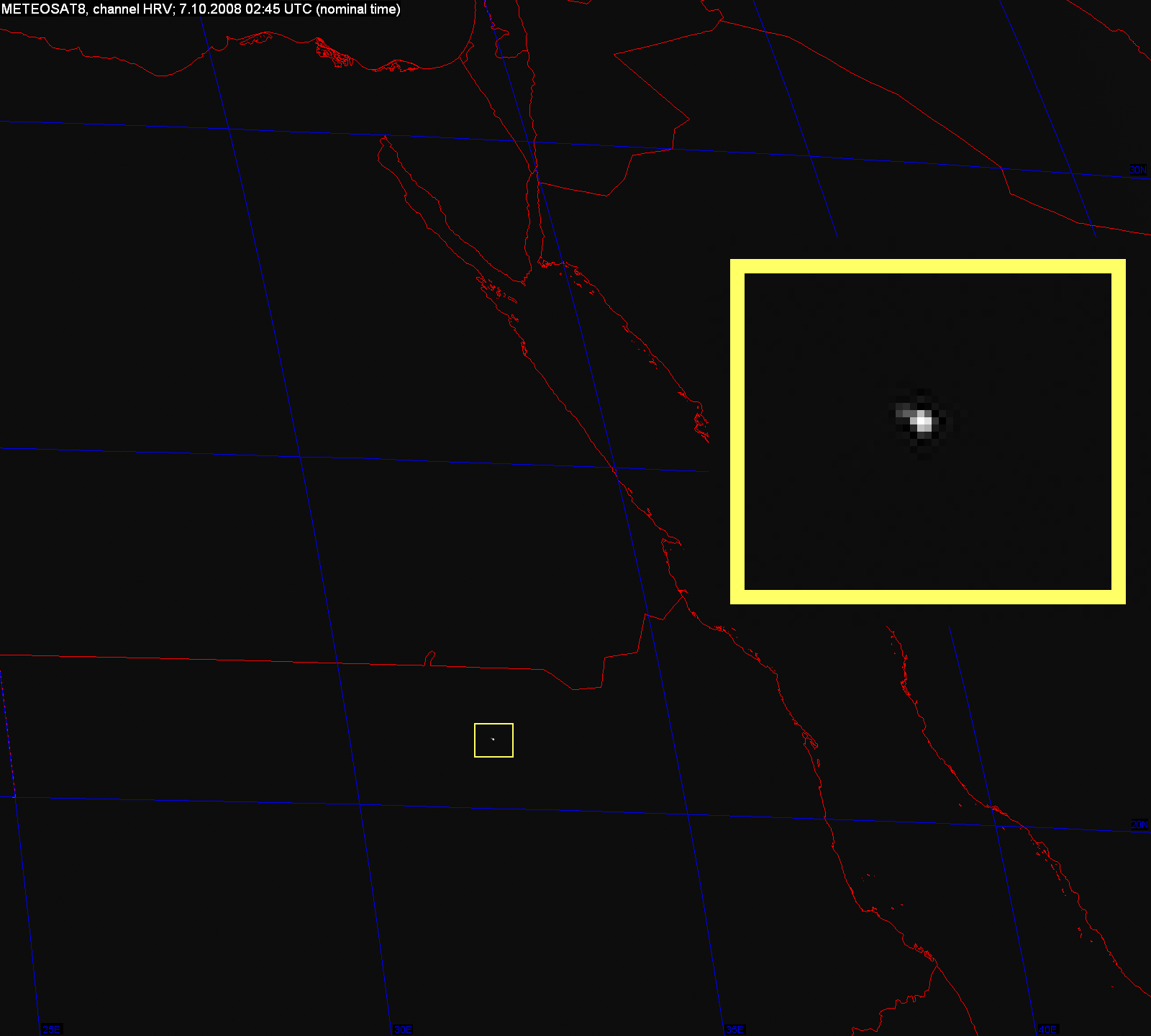
(Updated Oct. 8th) On Oct. 7th, asteroid 2008 TC3 hit Earth and exploded in the atmosphere over northern Sudan. An infrasound array in Kenya recorded the impact: map. Dr. Peter Brown of the University of Western Ontario has inspected the data and he estimates that the asteroid hit at 0243 UTC with an energy between 1.1 and 2.1 kilotons of TNT. The explosion was imaged by the weather satellite Meteosat 8:
"The explosion was visible in all 12 of the satellite's spectral channels, covering wavelengths from 0.5 to 14 microns," says Jiri Borovicka
of the Czech Academy of Sciences, who is analyzing the data. "The satellite takes pictures every five minutes; the fireball appeared at 0245 UTC and had faded away by 0250 UTC."
So far, no ground pictures of the fireball have been submitted; the impact occurred in a remote area with few and possibly no onlookers capable of recording the event. The only report of a visual sighting comes from Jacob Kuiper, General Aviation meteorologist at the National Weather Service in the Netherlands:
"Half an hour before the predicted impact of asteroid 2008 TC3, I informed an official of Air-France-KLM at Amsterdam airport about the possibility that crews of their airliners in the vicinity of impact would have a chance to see a fireball. And it was a success! I have received confirmation that a KLM airliner, roughly 750 nautical miles southwest of the predicted atmospheric impact position, has observed a short flash just before the expected impact time 0246 UTC. Because of the distance it was not a very large phenomenon, but still a confirmation that some bright meteor has been seen in the predicted direction. Projected on an infrared satellite image from Meteosat 7, I have indicated the position of the plane (+) and the predicted impact area in Sudan (0)."
2008 TC3 was discovered on Oct. 6th by astronomers using the Mt. Lemmon telescope in Arizona as part of the NASA-funded Catalina Sky Survey for near-Earth objects. Asteroids the size of 2008 TC3 hit Earth 5 to 10 times a year, but this is the first time one has been discovered before it hit.
BONUS: 2008 TC3 was so close to Earth, different observers around the globe saw the asteroid trace different paths among the stars. This effect, called parallax, is beautifully illustrated in a compilation of 566 published observations prepared by Matthias Busch: image.
Link: SpaceWeather.com
(Updated Oct. 8th) On Oct. 7th, asteroid 2008 TC3 hit Earth and exploded in the atmosphere over northern Sudan. An infrasound array in Kenya recorded the impact: map. Dr. Peter Brown of the University of Western Ontario has inspected the data and he estimates that the asteroid hit at 0243 UTC with an energy between 1.1 and 2.1 kilotons of TNT. The explosion was imaged by the weather satellite Meteosat 8:
"The explosion was visible in all 12 of the satellite's spectral channels, covering wavelengths from 0.5 to 14 microns," says Jiri Borovicka
of the Czech Academy of Sciences, who is analyzing the data. "The satellite takes pictures every five minutes; the fireball appeared at 0245 UTC and had faded away by 0250 UTC."
So far, no ground pictures of the fireball have been submitted; the impact occurred in a remote area with few and possibly no onlookers capable of recording the event. The only report of a visual sighting comes from Jacob Kuiper, General Aviation meteorologist at the National Weather Service in the Netherlands:
"Half an hour before the predicted impact of asteroid 2008 TC3, I informed an official of Air-France-KLM at Amsterdam airport about the possibility that crews of their airliners in the vicinity of impact would have a chance to see a fireball. And it was a success! I have received confirmation that a KLM airliner, roughly 750 nautical miles southwest of the predicted atmospheric impact position, has observed a short flash just before the expected impact time 0246 UTC. Because of the distance it was not a very large phenomenon, but still a confirmation that some bright meteor has been seen in the predicted direction. Projected on an infrared satellite image from Meteosat 7, I have indicated the position of the plane (+) and the predicted impact area in Sudan (0)."
2008 TC3 was discovered on Oct. 6th by astronomers using the Mt. Lemmon telescope in Arizona as part of the NASA-funded Catalina Sky Survey for near-Earth objects. Asteroids the size of 2008 TC3 hit Earth 5 to 10 times a year, but this is the first time one has been discovered before it hit.
BONUS: 2008 TC3 was so close to Earth, different observers around the globe saw the asteroid trace different paths among the stars. This effect, called parallax, is beautifully illustrated in a compilation of 566 published observations prepared by Matthias Busch: image.

Link: SpaceWeather.com
07 October 2008
JPL: "Impact of Asteroid 2008 TC3 Confirmed"
Impact of Asteroid 2008 TC3 Confirmed
Don Yeomans
NASA/JPL Near-Earth Object Program Office
October 7, 2008
Confirmation has been received that the asteroid impact fireball occurred at the predicted time and place. The energy recorded was estimated to be 0.9 to 1.0 kT of TNT and the time of detection was 02:45:45 on October 7 (Greenwich Standard Time). More details on this detection will be forthcoming. An additional confirmation was apparently reported by a KLM airliner (see: http://www.spaceweather.com/). As reported by Peter Brown (University of Western Ontario, Canada), a preliminary examination of infrasound stations nearest to the predicted impact point shows that at least one station recorded the event. These measurements are consistent with the predicted time and place of the atmospheric impact and indicate an estimated energy of 1.1 - 2.1 kT of TNT.
The follow-up astrometric observations from professional and sophisticated amateur astronomers alike were rather extraordinary, with 570 observations from 26 observatories being reported between the time of discovery by the Catalina Sky Survey to just before the object entered Earth's shadow (57 minutes prior to impact). All this happened in less than 19 hours!
Link: JPL NEO Site Press Release: Impact of Asteroid 2008 TC3 Confirmed
Update on 2008 TC3 Impact
From SpaceWeather.com...

Projected on an infrared satellite-image of Meteosat-7 of 0300 UTC, indicated the position of the plane (+) and the predicted impact area in Sudan (0)."
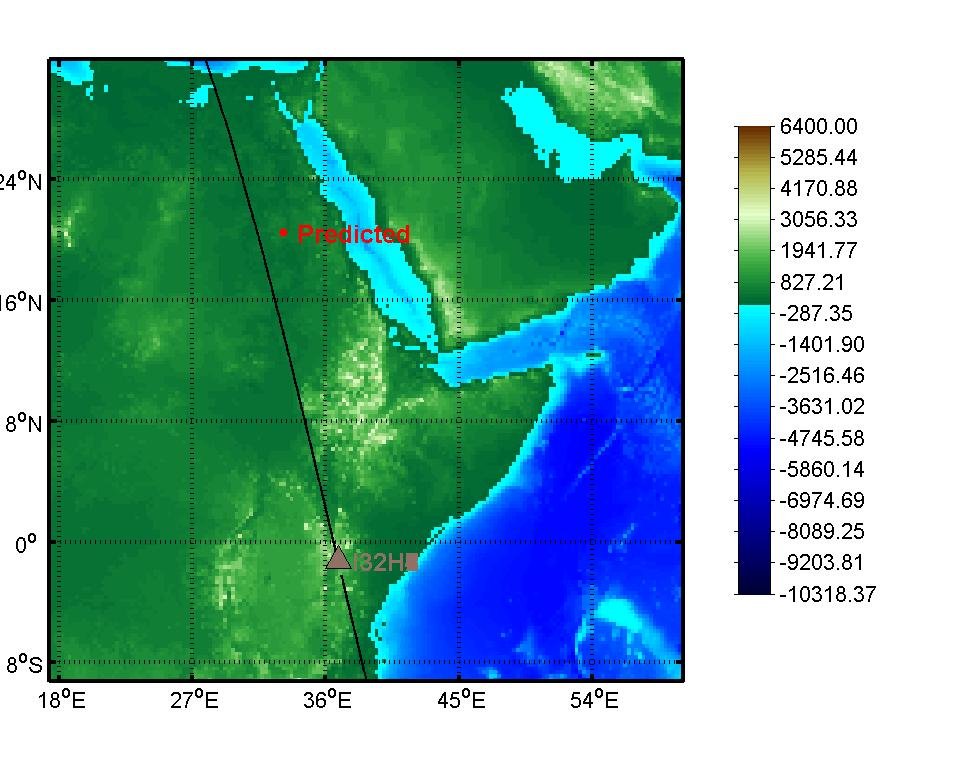
Image credit: Peter Brown, University of Western Ontario
ASTEROID IMPACT--UPDATE: Asteroid 2008 TC3 hit Earth this morning, Oct. 7th, and exploded in the atmosphere over northern Sudan. An infrasound array in Kenya recorded the impact. Dr. Peter Brown of the University of Western Ontario has inspected the data and he estimates that the asteroid hit at 0243 UTC with an energy between 1.1 and 2.1 kilotons of TNT. Most of the 3-meter-wide space rock should have been vaporized in the atmosphere with only small pieces reaching the ground as meteorites.
No pictures of the fireball have been submitted; the impact occurred in a remote area with few and possibly no onlookers capable of recording the event. So far, the only report of a visual sighting comes from Jacob Kuiper, General Aviation meteorologist at the National Weather Service in the Netherlands:
"Half an hour before the predicted impact of asteroid 2008 TC3, I informed an official of Air-France-KLM at Amsterdam airport about the possibility that crews of their airliners in the vicinity of impact would have a chance to see a fireball. And it was a success! I have received confirmation that a KLM airliner, roughly 750 nautical miles southwest of the predicted atmospheric impact position, has observed a short flash just before the expected impact time 0246 UTC. Because of the distance it was not a very large phenomenon, but still a confirmation that some bright meteor has been seen in the predicted direction. Projected on an infrared satellite-image of Meteosat-7 of 0300 UTC, I have indicated the position of the plane (+) and the predicted impact area in Sudan (0)."
2008 TC3 was discovered on Oct. 6th by astronomers using the Mt. Lemmon telescope in Arizona as part of the NASA-funded Catalina Sky Survey for near-Earth objects. Asteroids the size of 2008 TC3 hit Earth 5 to 10 times a year, but this is the first time one has been discovered before it hit.
pre-impact images: from Paolo Beltrame of CAST Astronomical Observatory, Talmassons, Italy; from Eric Allen of Observatoire du Cegep de Trois-Rivieres, Champlain, Québec; from Ernesto Guido et al. of Remanzacco Observatory, Italy; from S.Korotkiy and T.Kryachko of Kazan State University Astrotel observatory, Russia;
Link: SpaceWeather.com
Projected on an infrared satellite-image of Meteosat-7 of 0300 UTC, indicated the position of the plane (+) and the predicted impact area in Sudan (0)."
Image credit: Peter Brown, University of Western Ontario
ASTEROID IMPACT--UPDATE: Asteroid 2008 TC3 hit Earth this morning, Oct. 7th, and exploded in the atmosphere over northern Sudan. An infrasound array in Kenya recorded the impact. Dr. Peter Brown of the University of Western Ontario has inspected the data and he estimates that the asteroid hit at 0243 UTC with an energy between 1.1 and 2.1 kilotons of TNT. Most of the 3-meter-wide space rock should have been vaporized in the atmosphere with only small pieces reaching the ground as meteorites.
No pictures of the fireball have been submitted; the impact occurred in a remote area with few and possibly no onlookers capable of recording the event. So far, the only report of a visual sighting comes from Jacob Kuiper, General Aviation meteorologist at the National Weather Service in the Netherlands:
"Half an hour before the predicted impact of asteroid 2008 TC3, I informed an official of Air-France-KLM at Amsterdam airport about the possibility that crews of their airliners in the vicinity of impact would have a chance to see a fireball. And it was a success! I have received confirmation that a KLM airliner, roughly 750 nautical miles southwest of the predicted atmospheric impact position, has observed a short flash just before the expected impact time 0246 UTC. Because of the distance it was not a very large phenomenon, but still a confirmation that some bright meteor has been seen in the predicted direction. Projected on an infrared satellite-image of Meteosat-7 of 0300 UTC, I have indicated the position of the plane (+) and the predicted impact area in Sudan (0)."
2008 TC3 was discovered on Oct. 6th by astronomers using the Mt. Lemmon telescope in Arizona as part of the NASA-funded Catalina Sky Survey for near-Earth objects. Asteroids the size of 2008 TC3 hit Earth 5 to 10 times a year, but this is the first time one has been discovered before it hit.
pre-impact images: from Paolo Beltrame of CAST Astronomical Observatory, Talmassons, Italy; from Eric Allen of Observatoire du Cegep de Trois-Rivieres, Champlain, Québec; from Ernesto Guido et al. of Remanzacco Observatory, Italy; from S.Korotkiy and T.Kryachko of Kazan State University Astrotel observatory, Russia;
Link: SpaceWeather.com
NEO News (10/07/08) First reports on Sudan bolide
From Dave Morrison...
NEO News (10/07/08) First reports on Sudan bolide
While I have not yet seen any eyewitness accounts from ground observers in Africa, here are two early reports that the bolide (now designated as asteroid 2008 TC3, surely the shortest-lived asteroid name, since it was destroyed a few hours after the name was given) did explode in the atmosphere above Sudan early this morning.
David Morrison
==============================
From Peter Brown (pbrown@uwo.ca): A very preliminary examination of several infrasound stations proximal to the predicted impact point for the NEO 2008 TC3 has yielded one definite airwave detection from the impact. The airwave was detected at the Kenyian Infrasonic Array, (IMS station IS32), beginning near 05:10 UT on Oct 7, 2008 and lasting for several minutes. The signal correlation was highest at very low frequencies - the dominant period of the waveform was 5-6 seconds. The backazimuth of the signal over the entire 7 element array is shown in the attached map - it clearly points to within a few degrees of the expected arrival direction. Moreover, assuming a stratospheric mean signal speed of 0.28 km/s, the arrival time corresponds to an origin time near 02:43 UT, which is consistent with the expected impact time near 02:45:40 UT given expected variations in stratospheric arrival speeds. The dominant period of 5-6 seconds corresponds to an estimated energy (using the AFTAC period at maximum amplitude relationship from ReVelle, 1997) of 1.1 - 2.1 kilotons of TNT. The five other closest infrasound stations were briefly examined for obvious signals and showed none - more detailed signal processing of these additional data are ongoing in the search for additional signals.
Peter Brown
Canada Research Chair in Meteor Science
University of Western Ontario, London, ON
=============================
From Spaceweather.com: ASTEROID IMPACT--UPDATE: Asteroid 2008 TC3 hit Earth this morning, Oct. 7th, and exploded in the atmosphere over northern Sudan. An infrasound array in Kenya recorded the impact. Dr. Peter Brown of the University of Western Ontario has inspected the data and he estimates that the asteroid hit at 0243 UTC with an energy between 1.1 and 2.1 kilotons of TNT. Most of the 3-meter-wide space rock should have been vaporized in the atmosphere with only small pieces reaching the ground as meteorites.
No pictures of the fireball have been submitted; the impact occurred in a remote area with few and possibly no onlookers capable of recording the event. So far, the only report of a visual sighting comes from Jacob Kuiper, General Aviation meteorologist at the National Weather Service in the Netherlands:
"Half an hour before the predicted impact of asteroid 2008 TC3, I informed an official of Air-France-KLM at Amsterdam airport about the possibility that crews of their airliners in the vicinity of impact would have a chance to see a fireball. And it was a success! I have received confirmation that a KLM airliner, roughly 750 nautical miles southwest of the predicted atmospheric impact position, has observed a short flash just before the expected impact time 0246 UTC. Because of the distance it was not a very large phenomenon, but still a confirmation that some bright meteor has been seen in the predicted direction.
=============================
Erik Asphaug of University of California, Santa Cruz, asks rhetorically: How would the US respond if the identical impact was forecast over, say, Bozeman? On the one hand we expect that the public would behave themselves, but some in the discussion felt that the public would freak out entirely out of proportion.
David Morrison comments: This issue of public response to a very small impact has been discussed previously, including mention in three of my papers (see below), but in fact no one knows the answer. The issue is important because impacts this small are relatively common:
Morrison, D., R. Binzel, C.R. Chapman, and D. Steel, "Impacts and the Public: Communicating the Nature of the Impact Hazard." In Mitigation of Hazardous Comets and Asteroids (M. Belton, T. Morgan, N. Samarasinha & D. Yeomans, eds.). Cambridge University Press, Cambridge (2004).
Morrison, D. "Defending the Earth against Asteroids: The Case for a Global Response," Science and Global Security 13:105-116 (2005).
Morrison, D. "The Impact Hazard: Advanced NEO Surveys and Societal responses," In Comet/Asteroid Impacts and Human Society (P. Bobrowsky & H. Rickman, eds.) Springer, New York (2007)
--
+++++++++++++++++++++++++++++++++++++++++++
NEO News (now in its fourteenth year of distribution) is an informal compilation of news and opinion dealing with Near Earth Objects (NEOs) and their impacts. These opinions are the responsibility of the individual authors and do not represent the positions of NASA, Ames Research Center, the International Astronomical Union, or any other organization. To subscribe (or unsubscribe) contact dmorrison@arc.nasa.gov. For additional information, please see the website http://impact.arc.nasa.gov. If anyone wishes to copy or redistribute original material from these notes, fully or in part, please include this disclaimer.
Animation of impact from the asteroid's point of view

From the website:
We [Pasquale Tricarico of the Planetary Science Institute] has prepared a short animation, showing the Earth as viewed by the asteroid 2008 TC3. The asteroid is reaching Earth from the night side, and enters the Earth's shadow cone around 1:50 UTC.
Link: Animation of impact from the asteroid's point of view (Pasquale Tricarico of the Planetary Science Institute)
2008 TC3 (Images and Video)

From Astronomy.com blog:
First images of asteroid 2008 TC3
Posted 10-07-2008 by Matt Quandt
This morning, the husband and wife observing team of Imelda Joson and Edwin Aguirre forwarded to Astronomy an image and an animation of the asteroid 2008 TC3 they received from amateur astronomer friends in Italy. Imelda runs an image service company and is a contributor to Astronomy magazine.
"Here's a sequence of photos and animation of 2008 TC3 taken by our astronomer friends in Italy," Imelda writes. "They're among the first (if not the first) amateur images of the object."
Link: Video of October 6 asteroid 2008 TC3 (Astronomy.com)
Link: First images of asteroid 2008 TC3 (Astronomy.com blog)
Video Reports on 2008 TC3
From JPl News:
An asteroid measuring several feet in diameter is expected to enter the atmosphere over northern Sudan before dawn Tuesday, setting off a potentially brilliant natural fireworks display. (Oct. 6)
Link: YouTube Video
From KTVUTV (California):
MOUNTAIN VIEW: Lloyd LaCuesta Reports On First Successful Asteroid Impact Forecast
Link: YouTube Video
From CelestiaDev (YouTube):
Final few minutes of asteroid 2008 TC3 before it burns up in Earth's atmosphere. Trajectory of 2008 TC3 from HORIZONS. Green circle indicates area of Earth's surface where the asteroid appears above the horizon.
Link: YouTube Video
The view from asteroid 2008 TC3 in the minutes before it enters Earth's atmosphere. The point of entry is on the night side of Earth, so the brightness of Earth has been enhanced for the visualization. We don't know what the shape of 2008 TC3, so I've substituted a model of the asteroid Itokawa. The time rate is 20x normal.
Link: YouTube Video
From walcom77 (YouTube):
Animation showing the motion of small asteroid 2008 TC3 few hours before to enter Earth atmosphere. Images obtained at Remanzacco Observatory by G. Sostero, E. Guido & V. Gonano
Link: YouTube Video
From observatorij (YouTube):
A tiny asteroid 2008 TC3 was discovered by astronomers a day before it entered the atmosphere in Northern Sudan and exploded. The video shows animated motion between the stars few hours before the impact. Images taken from the Črni Vrh Observatory in Slovenia with a 60 cm telescope and a CCD camera. http://www.observatorij.org
Link: YouTube Video
From gusmul1 (YouTube):
imagenes en video de la noche del 6-10-2008 del asteroide con menor vida conocida en el mundo de la astrometria. colisionó con la atmósfera terrestre sobre sudan. g
Link: YouTube Video
2008 TC3 Update

Overhead view showing 2008 TC3's trajectory to Earth. Tick marks are in 15 minute increments.

Movie showing the discovery images of 2008 TC. Images taken at around 06:30 UTC on October 6, 2008. The asteroid was at 19th magnitude and moving at 2.5 degrees per day. Image Credit: Richard Kowalski and Ed Beshore, Catalina Sky Survey
Small Asteroid Predicted to Cause Brilliant Fireball over Northern Sudan
Don Yeomans
NASA/JPL Near-Earth Object Program Office
October 6, 2008
A very small, few-meter sized asteroid, designated 2008 TC3, was found Monday morning by the Catalina Sky Survey from their observatory near Tucson Arizona. Preliminary orbital computations by the Minor Planet Center suggested an atmospheric entry of this object within a day of discovery. JPL confirmed that an atmospheric impact will very likely occur during early morning twilight over northern Sudan, north-eastern Africa, at 2:46 UT Tuesday morning. The fireball, which could be brilliant, will travel west to east (from azimuth = 281 degrees) at a relative atmospheric impact velocity of 12.8 km/s and arrive at a very low angle (19 degrees) to the local horizon. It is very unlikely that any sizable fragments will survive passage through the Earth's atmosphere.
Objects of this size would be expected to enter the Earth's atmosphere every few months on average but this is the first time such an event has been predicted ahead of time.
Update - 6:45 PM PDT (1 hour prior to atmospheric entry)
Since its discovery barely a day ago, 2008 TC3 has been observed extensively by astronomers around the world, and as a result, our orbit predictions have become very precise. We estimate that this object will enter the Earth's atmosphere at around 2:45:28 UTC and reach maximum deceleration at around 2:45:54 UTC. These times are uncertain by +/- 15 seconds or so. The time at which any fragments might reach the ground depends a great deal on the physical properties of the object, but should be around 2:46:20 UTC +/- 40 seconds.
Link: Press release from the Near-Earth Object Project Office at NASA JPL
Link: Minor Planet Center
NEO News (10/06/08): Bolide impact predicted
From Dave Morrison's NEO news
NEO News (10/06/08) Bolide impact predicted tonight!
This is a first: a very small asteroid (or rock) has been discovered that is on course for an impact tonight in Sudan. This information is from various reports to posted to MPML (the Minor Planet Mailing List at groups.yahoo.com/group/mpml/). The impactor is only about 2 m across and will break up in the atmosphere, with no risk to those on the ground. (If something this size hit in the daytime, it would probably not be noticed, but at night it should put on quite show).
Alan Harris writes that this object, with the survey-assigned designation 8TA9D69, was discovered by the University of Arizona Mt. Lemmon survey and will almost certainly, tonight, become the first impacting bolide discovered before entry into the Earth's atmosphere. Steve Chesley (JPL) reports that atmospheric entry will occur on 2008 Oct 07 0246 UTC over northern Sudan.
Andrea Milani of the University of Pisa wrote the following: Today the object with the provisional designation 8TA9D69 was submitted to impact monitoring by using the normal software of the NEODyS system, by using the observations as reported by the MPC on the NEO Confirmation Page. Based on 26 optical observations from 2008/10/06.278 to 2008/10/06, the probability of impact is between 99.8% and 100%; in practice the impact can be considered sure and is for tonight. Our computation has already been confirmed independently by others, including the JPL NEO Program Office (with which we consult in all relevant cases of possible impact). The effect of this atmospheric impact will be the release, in either a single shot or maybe a sequence of explosions, of about 1 kiloton of energy. This means that the damage on the ground is expected to be zero. The location of these explosions is not easy to predict due to the atmospheric braking effects. The only concern is that they might be interpreted as something else, that is man-made explosions. Thus in this case, the earlier the public worldwide is aware that this is a natural phenomenon, which involves no risk, the better.
This is the first time an asteroid impact has been predicted, and it reflects the increasing capability of the Spaceguard Survey. There was one previous false alarm when, for a few hours around Christmas 2004, it appeared that an impact by a 30-m asteroid was possible, but this was ruled out by additional observations. The current case, however, seems much more solid.
David Morrison
Subscribe to:
Posts (Atom)