
Edward M. Lerner has a new fiction book entitled "Energized" coming out in July 2012 on Solar Power Satellites and how they help humanity in a future energy crisis. Here are some details from Amazon.com...
No one expected the oil to last forever. How right they were ....
A geopolitical miscalculation tainted the world's major oil fields with radioactivity and plunged the Middle East into chaos. Any oil that remains usable is more prized than ever. No one can build solar farms, wind farms, and electric cars quickly enough to cope. The few countries still able to export oil and natural gas -- Russia chief among them -- have a stranglehold on the world economy.
And then, from the darkness of space, came Phoebe. Rather than divert the onrushing asteroid, America captured it into Earth orbit.
Solar power satellites -- cheaply mass-produced in orbit with resources mined from the new moon, to beam vast amounts of power to the ground -- offer America its last, best hope of avoiding servitude and economic ruin.
As though building miles-across structures in space isn't challenging enough, special interests, from technophobes to eco-extremists to radio astronomers, want to stop the project. And the remaining petro powers will do anything to protect their newfound dominance of world affairs.
NASA engineer Marcus Judson is determined to make the powersat demonstration project a success. And he will -- even though nothing in his job description mentions combating an international cabal, or going into space to do it.
Link: Amazon.com ("Energized")
09 June 2012
New Don Yeomans book ("Near-Earth Objects: Finding Them Before They Find Us") on planetary defense coming out in November 2012

Donald K. Yeomans (Manager, NASA’s Near-Earth Object Program Office at JPL) has a new book entitled "Near-Earth Objects: Finding Them Before They Find Us" coming out in November 2012. Here are some details from Amazon.com...
Of all the natural disasters that could befall us, only an Earth impact by a large comet or asteroid has the potential to end civilization in a single blow. Yet these near-Earth objects also offer tantalizing clues to our solar system's origins, and someday could even serve as stepping-stones for space exploration. In this book, Donald Yeomans introduces readers to the science of near-Earth objects--its history, applications, and ongoing quest to find near-Earth objects before they find us.
In its course around the sun, the Earth passes through a veritable shooting gallery of millions of nearby comets and asteroids. One such asteroid is thought to have plunged into our planet sixty-five million years ago, triggering a global catastrophe that killed off the dinosaurs. Yeomans provides an up-to-date and accessible guide for understanding the threats posed by near-Earth objects, and also explains how early collisions with them delivered the ingredients that made life on Earth possible. He shows how later impacts spurred evolution, allowing only the most adaptable species to thrive--in fact, we humans may owe our very existence to objects that struck our planet.
Yeomans takes readers behind the scenes of today's efforts to find, track, and study near-Earth objects. He shows how the same comets and asteroids most likely to collide with us could also be mined for precious natural resources like water and oxygen, and used as watering holes and fueling stations for expeditions to Mars and the outermost reaches of our solar system.
Link: Amazon.com ("Near-Earth Objects: Finding Them Before They Find Us")


Call for Papers for 2013 Planetary Defense Conference Near Meteor Crater, AZ USA (Theme: Gathering for Impact!”)
The preliminary website and call for papers for the 2013 IAA Planetary Defense Conference has been released. The conference will be 15-19 April 2013 in Flagstaff, Arizona (near Meteor Crater). This a continuation of the Planetary Defense conferences that have been held in the past few years (in 2004, 2007, 2009, and 2011). Here is more information on the 2011 conference (presentation from Bill Ailor) and the 2011 conference website.
From the IAA website for the 2013 Planetary Defense Conference...
Papers are solicited for the 2013 IAA Planetary Defense Conference sponsored by the International Academy of Astronautics (IAA), National Aeronautics and Space Administration (NASA), the European Space Agency (ESA), and The Aerospace Corporation (information on sponsorships is available at http://iaaweb.org/content/view/497/666/ ). The theme for the conference is “Gathering for Impact!”
Papers are solicited in the following areas:
Potentially Hazardous Objects – Recent Progress
· Current funded projects
· Discovery statistics and projections (ground-based & space-based)
· Orbital refinements including non-gravitational effects and keyholes
· Lessons learned from recent discoveries and close approaches
· Physical characterization that informs mitigation
Discovery and Tracking Resources and Plans
· Program status and plans (e.g., NASA’s NEO program, ESA’s SSA program)
· Survey completion estimates; ground-based and space-based surveys
· The status of next generation surveys (e.g., PanSTARRS and LSST)
· The discovery and tracking of 50-meter class PHOs
· Threat evolution with time – refining the threat
· Advancements in utilizing archival and historical data
Impacts, Consequences and Education
· Information from the geological record and recent history
· Consequences of ocean and land impacts
· Planning for a short or no warning time event
· Public/media education on NEO detection, impact effects, mitigation missions, impact warnings
Mission & Campaign Planning & Technologies
· Mission and campaign designs aimed at deflection/disruption, and related to their TRL.
· Human and robotic campaigns that inform all three NEO issues: science, exploration and planetary defense
· Decision tree, timelines and decision-to-act criteria (e.g., Impact probability thresholds)
· What do we do if a threat is detected tomorrow?
Disaster Mitigation
· Actual local, regional, international disasters that provide insights for NEO impact warning and mitigation
· Current international agreements and coordination activities
· Organizing and managing an international effort noting the consequences of false alarms
· Impact of public opinion on decision to act and choice of mitigation method
Moving Forward on Planetary Defense
· Funding levels and priority actions to build and maintain readiness
· Current national and international funded activities that support planetary defense
Link: International Academy of Astronautics (IAA) website for the 2012 IAA Planetary Defense Conference
From the IAA website for the 2013 Planetary Defense Conference...
Papers are solicited for the 2013 IAA Planetary Defense Conference sponsored by the International Academy of Astronautics (IAA), National Aeronautics and Space Administration (NASA), the European Space Agency (ESA), and The Aerospace Corporation (information on sponsorships is available at http://iaaweb.org/content/view/497/666/ ). The theme for the conference is “Gathering for Impact!”
Papers are solicited in the following areas:
Potentially Hazardous Objects – Recent Progress
· Current funded projects
· Discovery statistics and projections (ground-based & space-based)
· Orbital refinements including non-gravitational effects and keyholes
· Lessons learned from recent discoveries and close approaches
· Physical characterization that informs mitigation
Discovery and Tracking Resources and Plans
· Program status and plans (e.g., NASA’s NEO program, ESA’s SSA program)
· Survey completion estimates; ground-based and space-based surveys
· The status of next generation surveys (e.g., PanSTARRS and LSST)
· The discovery and tracking of 50-meter class PHOs
· Threat evolution with time – refining the threat
· Advancements in utilizing archival and historical data
Impacts, Consequences and Education
· Information from the geological record and recent history
· Consequences of ocean and land impacts
· Planning for a short or no warning time event
· Public/media education on NEO detection, impact effects, mitigation missions, impact warnings
Mission & Campaign Planning & Technologies
· Mission and campaign designs aimed at deflection/disruption, and related to their TRL.
· Human and robotic campaigns that inform all three NEO issues: science, exploration and planetary defense
· Decision tree, timelines and decision-to-act criteria (e.g., Impact probability thresholds)
· What do we do if a threat is detected tomorrow?
Disaster Mitigation
· Actual local, regional, international disasters that provide insights for NEO impact warning and mitigation
· Current international agreements and coordination activities
· Organizing and managing an international effort noting the consequences of false alarms
· Impact of public opinion on decision to act and choice of mitigation method
Moving Forward on Planetary Defense
· Funding levels and priority actions to build and maintain readiness
· Current national and international funded activities that support planetary defense
Link: International Academy of Astronautics (IAA) website for the 2012 IAA Planetary Defense Conference
08 June 2012
Russian KAPKAN and KAISSA Asteroid Intercept Mission Design
From a presentation last year from V.G.Degtyar, V.A.Volkov, S.T.Kalashnikov on the Russian KAPKAN and KAISSA mission design for observation, penetration, and nuclear mitigation spacecraft approaches. The spacecraft are defined as follows:
1) KAPKAN
Universal spacecraft (UKA), containing one or more impact modules capable to break a HSO or decline its orbit
2) KAISSA
Reconnaissance space vehicle containing one or more information modules planned to be used to
analyze the structure and composition of a hazardous asteroid on the trajectory of its motion
Within the last 15 years GRTs “Academician V.P. Makeyev Design Bureau" in cooperation with scientific community of the Ural and Siberian Branches of the Russian Academy of Sciences have been carrying out initiative researches pursuing the aim to create a national (global) system of protection against asteroids and comets. The following activities are under way to create a rocket component of the national system in the short term (10-15 years):
− studies of payload performance and accuracy of the available and future rocket complexes for launching potential aids impacting on Hazardous Space Objects (HSOs);
− studies of power-and-mass characteristics and parameters of injection of the power modules capable to counteract the HSOs or to decline their trajectories with eco-friendly means or to destroy them into fragments that will burn in the atmosphere;
− studies of the efficiency of various scenarios for protection against asteroids and comets.
Link: PDF
A little more information from a UPI article...
Makeyev State Missile Center officials warn that foreign cooperation could undercut Russian space programs.
Rising cooperation with the European Union has sidelined some Russian projects, particularly the future medium-class, enhanced-load rocket booster under development in Amur Oblast, said Makeyev State Missile Center General Director and Designer Vladimir Degtyar.
"It was very unfortunate that this effort was suspended," he said.
However, he said the Russians were participating in the European Union's 7th Framework Program for Space.
"To address the danger of asteroids, we have completed a draft concept for developing two spacecraft, the Kaissa and the Kapkan," Degtyar said. "The Kaissa is the scout and the Kapkan is the interceptor.
"Right now we are readying our proposals for the scope of financing for the Kapkan spacecraft's pilot project, Voenno-Promyshlennyi Kurier reported.
The Makeyev State Missile Center is the Russian Federation's leading developer and manufacturer of liquid-fuel, submarine-launched ballistic missiles.
1) KAPKAN
Universal spacecraft (UKA), containing one or more impact modules capable to break a HSO or decline its orbit
2) KAISSA
Reconnaissance space vehicle containing one or more information modules planned to be used to
analyze the structure and composition of a hazardous asteroid on the trajectory of its motion
Within the last 15 years GRTs “Academician V.P. Makeyev Design Bureau" in cooperation with scientific community of the Ural and Siberian Branches of the Russian Academy of Sciences have been carrying out initiative researches pursuing the aim to create a national (global) system of protection against asteroids and comets. The following activities are under way to create a rocket component of the national system in the short term (10-15 years):
− studies of payload performance and accuracy of the available and future rocket complexes for launching potential aids impacting on Hazardous Space Objects (HSOs);
− studies of power-and-mass characteristics and parameters of injection of the power modules capable to counteract the HSOs or to decline their trajectories with eco-friendly means or to destroy them into fragments that will burn in the atmosphere;
− studies of the efficiency of various scenarios for protection against asteroids and comets.
Link: PDF
A little more information from a UPI article...
Makeyev State Missile Center officials warn that foreign cooperation could undercut Russian space programs.
Rising cooperation with the European Union has sidelined some Russian projects, particularly the future medium-class, enhanced-load rocket booster under development in Amur Oblast, said Makeyev State Missile Center General Director and Designer Vladimir Degtyar.
"It was very unfortunate that this effort was suspended," he said.
However, he said the Russians were participating in the European Union's 7th Framework Program for Space.
"To address the danger of asteroids, we have completed a draft concept for developing two spacecraft, the Kaissa and the Kapkan," Degtyar said. "The Kaissa is the scout and the Kapkan is the interceptor.
"Right now we are readying our proposals for the scope of financing for the Kapkan spacecraft's pilot project, Voenno-Promyshlennyi Kurier reported.
The Makeyev State Missile Center is the Russian Federation's leading developer and manufacturer of liquid-fuel, submarine-launched ballistic missiles.
07 June 2012
British Astronomical Association Meeting on Observing Asteroids and Comets (06 Oct 2012)
From a Minor Planet Mailing List (mpml) post...
"OBSERVING PROJECTS WITH ASTEROID-COMET CONNECTIONS"
A joint meeting of the Comet Section and Asteroids and Remote
Planets Section of the BAA
at 10.00-17.00 hrs on Saturday, 2012 October 6
at the Berrill Lecture Theatre, Berrill Building, The Open University,
Walton Hall, Milton Keynes MK7 6AA, United Kingdom
Topics to include:
* Methods in common for observing asteroids and comets
* Discovering comets and asteroids
* Comets masquerading as asteroids
* Asteroids masquerading as comets
* Water ice in asteroids
* Short contributions from members
In addition, there will be keynote lectures by:
Dr Simon Green of The Open University
Dr Stephen Lowry and Dr Sam Duddy
of The University of Kent, Canterbury
Anyone wishing to contribute a short talk should contact Richard Miles or Guy
Hurst.
Travel directions to the Berrill Building can be found at:
http://www3.open.ac.uk/contact/locations.aspx
along with a map of the campus at:
http://www3.open.ac.uk/contact/maps/wh-campus.gif
More details of the programme will be made available in August.
Richard Miles
arps [at] britastro.org
Guy Hurst
guy [at] tahq.demon.co.uk
British Astronomical Association
Link: Minor Planet Center Post
"OBSERVING PROJECTS WITH ASTEROID-COMET CONNECTIONS"
A joint meeting of the Comet Section and Asteroids and Remote
Planets Section of the BAA
at 10.00-17.00 hrs on Saturday, 2012 October 6
at the Berrill Lecture Theatre, Berrill Building, The Open University,
Walton Hall, Milton Keynes MK7 6AA, United Kingdom
Topics to include:
* Methods in common for observing asteroids and comets
* Discovering comets and asteroids
* Comets masquerading as asteroids
* Asteroids masquerading as comets
* Water ice in asteroids
* Short contributions from members
In addition, there will be keynote lectures by:
Dr Simon Green of The Open University
Dr Stephen Lowry and Dr Sam Duddy
of The University of Kent, Canterbury
Anyone wishing to contribute a short talk should contact Richard Miles or Guy
Hurst.
Travel directions to the Berrill Building can be found at:
http://www3.open.ac.uk/contact/locations.aspx
along with a map of the campus at:
http://www3.open.ac.uk/contact/maps/wh-campus.gif

More details of the programme will be made available in August.
Richard Miles
arps [at] britastro.org
Guy Hurst
guy [at] tahq.demon.co.uk
British Astronomical Association
Link: Minor Planet Center Post
05 June 2012
Report: New Report: Hazardous Near Earth Objects - Communicating the Risk
New report from the Secure World Foundation on NEO Hazard Communication. Highlights from their news release...
To deal with potentially hazardous Near Earth Objects (NEOs) that could strike the Earth, there is need to establish an effective international communications strategy - but doing so is a daunting task, one that demands effective use of mass communication tools. That key view is addressed in The Near Earth Object Media/Risk Communications Working Group Report issued by Secure World Foundation. The report and its findings are being presented this week to the United Nations Committee on the Peaceful Uses of Outer Space (COPUOS) and its Action Team-14 on NEOs during the 55th session of the UN COPUOS being held in Vienna, Austria. The report stems from a two-day meeting held in November 2011, convened by Secure World Foundation (SWF) and the Association of Space Explorers (ASE). Nearly 40 scientists, reporters, risk communication specialists and SWF staff participating in the meeting, held at the University of Colorado, Boulder’s Laboratory for Atmospheric and Space Physics (LASP), Boulder, Colorado. The meeting concentrated on assisting the United Nations Action Team-14 (UN AT-14) on NEOs in its deliberations about the makeup and focus of an Information, Analysis and Warning Network (IAWN), designed to gather and analyze NEO data and provide timely warnings to national authorities should a potentially hazardous NEO threaten Earth.
Link: Press Release ("New Report: Hazardous Near Earth Objects - Communicating the Risk") Link: Space.com article
To deal with potentially hazardous Near Earth Objects (NEOs) that could strike the Earth, there is need to establish an effective international communications strategy - but doing so is a daunting task, one that demands effective use of mass communication tools. That key view is addressed in The Near Earth Object Media/Risk Communications Working Group Report issued by Secure World Foundation. The report and its findings are being presented this week to the United Nations Committee on the Peaceful Uses of Outer Space (COPUOS) and its Action Team-14 on NEOs during the 55th session of the UN COPUOS being held in Vienna, Austria. The report stems from a two-day meeting held in November 2011, convened by Secure World Foundation (SWF) and the Association of Space Explorers (ASE). Nearly 40 scientists, reporters, risk communication specialists and SWF staff participating in the meeting, held at the University of Colorado, Boulder’s Laboratory for Atmospheric and Space Physics (LASP), Boulder, Colorado. The meeting concentrated on assisting the United Nations Action Team-14 (UN AT-14) on NEOs in its deliberations about the makeup and focus of an Information, Analysis and Warning Network (IAWN), designed to gather and analyze NEO data and provide timely warnings to national authorities should a potentially hazardous NEO threaten Earth.
Link: Press Release ("New Report: Hazardous Near Earth Objects - Communicating the Risk") Link: Space.com article
02 June 2012
Video Animation of Planned Japanese Hayabusa 2 Mission
Video animation presented by Hitoshi Kuninaka from JAXA at the recent ISDC on future Japanes Hayabusa 2 asteroid mission:
Link: Twitvid
Link: Twitvid
Asteroid Impact & Deflection Assessment (AIDA) Mission Design: Joint ESA, JHU/APL, NASA, OCA and DLR Architecture


This was recently presented at the IAF/AIAA Global Space Exploration Conference (GLEX). Selections from an article by ESA...
The Asteroid Impact & Deflection Assessment (AIDA) mission is a joint effort of ESA, JHU/APL, NASA, OCA and DLR. The mission design foresees two independent spacecraft, one impactor (DART) and one rendezvous probe (AIM). As in the separate DART and AIM studies, the target of this mission is the binary asteroid system Didymos. For a successful joint mission, one spacecraft, DART, would impact the secondary of the Didymos binary system while AIM would observe and measure any the change in the relative orbit. The AIDA rendezvous spacecraft would be under responsibility of ESA.
ESA's Future Preparation and Strategy Studies Office commissioned a preliminary assessment at the Agency’s Concurrent Design Facility (CDF) in April 2012. The study concentrates on the design of a rendezvous mission. ESA’s spacecraft would arrive before APL’s impactor spacecraft in order to characterise the binary asteroid, and have the chance to observe the impact as well as the resulting ejecta and crater. The main objectives of the AIDA orbiter are:
- Determine binary asteroid orbital and rotation state
- Analyse size, mass and shape of both binary asteroid components
- Analyse geology and surface properties
The assessment considered two concepts (DART and AIM) that have been developed as two self standing missions. Joining the two missions will bring additional value, given by addressing the following supplementary objective for the rendezvous spacecraft:
- Observe the impact crater and derive collision and impact properties
Link: ESA Article
Recent Planetary Defense Related Technical Papers
Title: Development of a handbook and an on-line tool on defending Earth against Potentially Hazardous Objects
Author(s): Nahum Melamed, The Aerospace Corporation Received 3 February 2012. Accepted 21 March 2012.
Available online 23 April 2012.
Link: http://dx.doi.org/10.1016/j.actaastro.2012.03.021
Title: Hypervelocity nuclear interceptors for asteroid disruption
Author(s): B. Wie Vance Coffman Endowed Chair Professor, Asteroid Deflection Research Center, Department of Aerospace Engineering, Iowa State University Received 14 February 2012. Accepted 16 April 2012. Available online 4 May 2012.
Link: http://dx.doi.org/10.1016/j.actaastro.2012.04.028
Title: Deflecting earth-threatening asteroids using the solar collector: An improved model
Author(s): Gregory L. Matloff, Physics Department, New York City College of Technology, CUNY Received 22 November 2011. Revised 24 April 2012. Accepted 27 April 2012. Available online 29 May 2012.
Link: http://dx.doi.org/10.1016/j.actaastro.2012.04.028
Title: A comparison between rubble-pile and monolithic targets in impact simulations: Application to asteroid satellites and family size distributions
Author(s): Paula G. Benavideza, Daniel D. Durda, Brian L. Enke, William F. Bottke, David Nesvorný, Derek C. Richardson, Erik Asphaug, William J. Merline Received 29 March 2011. Revised 18 January 2012. Accepted 19 January 2012. Available online 17 February 2012.
Link: http://dx.doi.org/10.1016/j.icarus.2012.01.015
Title: Next Gen NEAR: Near Earth Asteroid Human Robotic Precursor Mission Concept
Author(s): Rivkin, Andrew S.; Kirby, Karen; Cheng, Andrew F.; Gold, Robert; Kelly, Daniel; Reed, Cheryl; Abell, Paul; Garvin, James; Landis, Rob Link: NASA Technical Reports Server
Link: PDF
Title: Comparing the Earth impact flux from comets and near-Earth asteroids
Author(s): Donald K. Yeomans, Alan B. Chamberlin, Jet Propulsion Laboratory, California Institute of Technology Received 20 January 2012. Revised 13 February 2012. Accepted 6 March 2012. Available online 5 April 2012.
Link: http://dx.doi.org/10.1016/j.actaastro.2012.04.028
Title: Finding Near-Earth Asteroid (NEA) Destinations for Human Exploration: Implications for Astrobiology
Author(s): Abell, P. A.; Mazanek, D. D.; Barbee, B. W.; Mink, R. G.; Landis, R. R.; Adamo, D. R.; Johnson, L. N.; Yeomans, D. K.; Reeves, D. M.; Larman, K. T.; Drake, B. G.; Friedensen, V. P.
Link: NASA Technical Reports Server
Link: PDF
Title: Human Missions to Near-Earth Asteroids: An Update on NASA's Current Status and Proposed Activities for Small Body Exploration
Author(s): Abell, P. A.; Mazanek, D. D.; Barbee, B. W.; Mink, R. G.; Landis, R. R.; Adamo, D. R.; Johnson, L. N.; Yeomans, D. K.; Reeves, D. M.; Larman, K. T.; Drake, B. G.; Friedensen, V. P.
Link: NASA Technical Reports Server
Link: PDF
Title: Human Mission to Asteroids in the Context of Future Space Exploration Studies
Author(s): P. Messidoro, F. Fenoglio, M. Pasquinelli, and J. Gottlieb, Thales Alenia Space Italia S.p.A.
Link: PDF
Author(s): Nahum Melamed, The Aerospace Corporation Received 3 February 2012. Accepted 21 March 2012.
Available online 23 April 2012.
Link: http://dx.doi.org/10.1016/j.actaastro.2012.03.021
Title: Hypervelocity nuclear interceptors for asteroid disruption
Author(s): B. Wie Vance Coffman Endowed Chair Professor, Asteroid Deflection Research Center, Department of Aerospace Engineering, Iowa State University Received 14 February 2012. Accepted 16 April 2012. Available online 4 May 2012.
Link: http://dx.doi.org/10.1016/j.actaastro.2012.04.028
Title: Deflecting earth-threatening asteroids using the solar collector: An improved model
Author(s): Gregory L. Matloff, Physics Department, New York City College of Technology, CUNY Received 22 November 2011. Revised 24 April 2012. Accepted 27 April 2012. Available online 29 May 2012.
Link: http://dx.doi.org/10.1016/j.actaastro.2012.04.028
Title: A comparison between rubble-pile and monolithic targets in impact simulations: Application to asteroid satellites and family size distributions
Author(s): Paula G. Benavideza, Daniel D. Durda, Brian L. Enke, William F. Bottke, David Nesvorný, Derek C. Richardson, Erik Asphaug, William J. Merline Received 29 March 2011. Revised 18 January 2012. Accepted 19 January 2012. Available online 17 February 2012.
Link: http://dx.doi.org/10.1016/j.icarus.2012.01.015
Title: Next Gen NEAR: Near Earth Asteroid Human Robotic Precursor Mission Concept
Author(s): Rivkin, Andrew S.; Kirby, Karen; Cheng, Andrew F.; Gold, Robert; Kelly, Daniel; Reed, Cheryl; Abell, Paul; Garvin, James; Landis, Rob Link: NASA Technical Reports Server
Link: PDF
Title: Comparing the Earth impact flux from comets and near-Earth asteroids
Author(s): Donald K. Yeomans, Alan B. Chamberlin, Jet Propulsion Laboratory, California Institute of Technology Received 20 January 2012. Revised 13 February 2012. Accepted 6 March 2012. Available online 5 April 2012.
Link: http://dx.doi.org/10.1016/j.actaastro.2012.04.028
Title: Finding Near-Earth Asteroid (NEA) Destinations for Human Exploration: Implications for Astrobiology
Author(s): Abell, P. A.; Mazanek, D. D.; Barbee, B. W.; Mink, R. G.; Landis, R. R.; Adamo, D. R.; Johnson, L. N.; Yeomans, D. K.; Reeves, D. M.; Larman, K. T.; Drake, B. G.; Friedensen, V. P.
Link: NASA Technical Reports Server
Link: PDF
Title: Human Missions to Near-Earth Asteroids: An Update on NASA's Current Status and Proposed Activities for Small Body Exploration
Author(s): Abell, P. A.; Mazanek, D. D.; Barbee, B. W.; Mink, R. G.; Landis, R. R.; Adamo, D. R.; Johnson, L. N.; Yeomans, D. K.; Reeves, D. M.; Larman, K. T.; Drake, B. G.; Friedensen, V. P.
Link: NASA Technical Reports Server
Link: PDF
Title: Human Mission to Asteroids in the Context of Future Space Exploration Studies
Author(s): P. Messidoro, F. Fenoglio, M. Pasquinelli, and J. Gottlieb, Thales Alenia Space Italia S.p.A.
Link: PDF
29 May 2012
Asteroid 2012 KT42: Very close approach to Earth today (29 May 2012) of ~5 meter NEO
Asteroid 2012 KT42

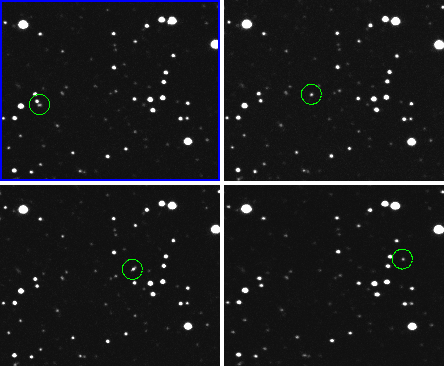
Discovery images of asteroid 2012 KT42. Credit: Catalina Sky Survey/Mt. Lemmon Observatory
Map of Transit

Newly-discovered asteroid 2012 KT42 is flying past Earth today (May 29th) only ~14,000 km above the planet's surface. This means 2012 KT42 will actually fly inside the Clark Belt of geosynchronous satellites. The 3- to 10-meter wide asteroid ranks # 6 on the top 20 list of closest-approachers to Earth. According to the asteroid's orbit, there is no danger of a collision. Even if it did hit, this space rock is too small to cause significant damage. It would likely disintegrate almost entirely in the atmosphere, peppering the ground below with relatively small meteorites.
Note: The close pass will occur at about 07:00 UTC (03:00 EDT, midnight PDT in the US) on May 29
Link: Universe Today
Link: Images from Flyby (courtesy of spaceweather.com)

Link: 2012 KT42 Page from JPL
Link: Blog post ( Remanzacco Observatory in Italy)
Link: Minor Planet Center on 2012 KT42
Link: Wikipedia page
Subscribe to:
Posts (Atom)