
From a presentation last year from V.G.Degtyar, V.A.Volkov, S.T.Kalashnikov on the Russian KAPKAN and KAISSA mission design for observation, penetration, and nuclear mitigation spacecraft approaches. The spacecraft are defined as follows:
1) KAPKAN
Universal spacecraft (UKA), containing one or more impact modules capable to break a HSO or decline its orbit
2) KAISSA
Reconnaissance space vehicle containing one or more information modules planned to be used to
analyze the structure and composition of a hazardous asteroid on the trajectory of its motion
Within the last 15 years GRTs “Academician V.P. Makeyev Design Bureau" in cooperation with scientific community of the Ural and Siberian Branches of the Russian Academy of Sciences have been carrying out initiative researches pursuing the aim to create a national (global) system of protection against asteroids and comets. The following activities are under way to create a rocket component of the national system in the short term (10-15 years):
− studies of payload performance and accuracy of the available and future rocket complexes for launching potential aids impacting on Hazardous Space Objects (HSOs);
− studies of power-and-mass characteristics and parameters of injection of the power modules capable to counteract the HSOs or to decline their trajectories with eco-friendly means or to destroy them into fragments that will burn in the atmosphere;
− studies of the efficiency of various scenarios for protection against asteroids and comets.
Link: PDF
A little more information from a UPI article...
Makeyev State Missile Center officials warn that foreign cooperation could undercut Russian space programs.
Rising cooperation with the European Union has sidelined some Russian projects, particularly the future medium-class, enhanced-load rocket booster under development in Amur Oblast, said Makeyev State Missile Center General Director and Designer Vladimir Degtyar.
"It was very unfortunate that this effort was suspended," he said.
However, he said the Russians were participating in the European Union's 7th Framework Program for Space.
"To address the danger of asteroids, we have completed a draft concept for developing two spacecraft, the Kaissa and the Kapkan," Degtyar said. "The Kaissa is the scout and the Kapkan is the interceptor.
"Right now we are readying our proposals for the scope of financing for the Kapkan spacecraft's pilot project, Voenno-Promyshlennyi Kurier reported.
The Makeyev State Missile Center is the Russian Federation's leading developer and manufacturer of liquid-fuel, submarine-launched ballistic missiles.
07 June 2012
British Astronomical Association Meeting on Observing Asteroids and Comets (06 Oct 2012)
From a Minor Planet Mailing List (mpml) post...
"OBSERVING PROJECTS WITH ASTEROID-COMET CONNECTIONS"
A joint meeting of the Comet Section and Asteroids and Remote
Planets Section of the BAA
at 10.00-17.00 hrs on Saturday, 2012 October 6
at the Berrill Lecture Theatre, Berrill Building, The Open University,
Walton Hall, Milton Keynes MK7 6AA, United Kingdom
Topics to include:
* Methods in common for observing asteroids and comets
* Discovering comets and asteroids
* Comets masquerading as asteroids
* Asteroids masquerading as comets
* Water ice in asteroids
* Short contributions from members
In addition, there will be keynote lectures by:
Dr Simon Green of The Open University
Dr Stephen Lowry and Dr Sam Duddy
of The University of Kent, Canterbury
Anyone wishing to contribute a short talk should contact Richard Miles or Guy
Hurst.
Travel directions to the Berrill Building can be found at:
http://www3.open.ac.uk/contact/locations.aspx
along with a map of the campus at:
http://www3.open.ac.uk/contact/maps/wh-campus.gif
More details of the programme will be made available in August.
Richard Miles
arps [at] britastro.org
Guy Hurst
guy [at] tahq.demon.co.uk
British Astronomical Association
Link: Minor Planet Center Post
"OBSERVING PROJECTS WITH ASTEROID-COMET CONNECTIONS"
A joint meeting of the Comet Section and Asteroids and Remote
Planets Section of the BAA
at 10.00-17.00 hrs on Saturday, 2012 October 6
at the Berrill Lecture Theatre, Berrill Building, The Open University,
Walton Hall, Milton Keynes MK7 6AA, United Kingdom
Topics to include:
* Methods in common for observing asteroids and comets
* Discovering comets and asteroids
* Comets masquerading as asteroids
* Asteroids masquerading as comets
* Water ice in asteroids
* Short contributions from members
In addition, there will be keynote lectures by:
Dr Simon Green of The Open University
Dr Stephen Lowry and Dr Sam Duddy
of The University of Kent, Canterbury
Anyone wishing to contribute a short talk should contact Richard Miles or Guy
Hurst.
Travel directions to the Berrill Building can be found at:
http://www3.open.ac.uk/contact/locations.aspx
along with a map of the campus at:
http://www3.open.ac.uk/contact/maps/wh-campus.gif

More details of the programme will be made available in August.
Richard Miles
arps [at] britastro.org
Guy Hurst
guy [at] tahq.demon.co.uk
British Astronomical Association
Link: Minor Planet Center Post


05 June 2012
Report: New Report: Hazardous Near Earth Objects - Communicating the Risk
New report from the Secure World Foundation on NEO Hazard Communication. Highlights from their news release...
To deal with potentially hazardous Near Earth Objects (NEOs) that could strike the Earth, there is need to establish an effective international communications strategy - but doing so is a daunting task, one that demands effective use of mass communication tools. That key view is addressed in The Near Earth Object Media/Risk Communications Working Group Report issued by Secure World Foundation. The report and its findings are being presented this week to the United Nations Committee on the Peaceful Uses of Outer Space (COPUOS) and its Action Team-14 on NEOs during the 55th session of the UN COPUOS being held in Vienna, Austria. The report stems from a two-day meeting held in November 2011, convened by Secure World Foundation (SWF) and the Association of Space Explorers (ASE). Nearly 40 scientists, reporters, risk communication specialists and SWF staff participating in the meeting, held at the University of Colorado, Boulder’s Laboratory for Atmospheric and Space Physics (LASP), Boulder, Colorado. The meeting concentrated on assisting the United Nations Action Team-14 (UN AT-14) on NEOs in its deliberations about the makeup and focus of an Information, Analysis and Warning Network (IAWN), designed to gather and analyze NEO data and provide timely warnings to national authorities should a potentially hazardous NEO threaten Earth.
Link: Press Release ("New Report: Hazardous Near Earth Objects - Communicating the Risk") Link: Space.com article
To deal with potentially hazardous Near Earth Objects (NEOs) that could strike the Earth, there is need to establish an effective international communications strategy - but doing so is a daunting task, one that demands effective use of mass communication tools. That key view is addressed in The Near Earth Object Media/Risk Communications Working Group Report issued by Secure World Foundation. The report and its findings are being presented this week to the United Nations Committee on the Peaceful Uses of Outer Space (COPUOS) and its Action Team-14 on NEOs during the 55th session of the UN COPUOS being held in Vienna, Austria. The report stems from a two-day meeting held in November 2011, convened by Secure World Foundation (SWF) and the Association of Space Explorers (ASE). Nearly 40 scientists, reporters, risk communication specialists and SWF staff participating in the meeting, held at the University of Colorado, Boulder’s Laboratory for Atmospheric and Space Physics (LASP), Boulder, Colorado. The meeting concentrated on assisting the United Nations Action Team-14 (UN AT-14) on NEOs in its deliberations about the makeup and focus of an Information, Analysis and Warning Network (IAWN), designed to gather and analyze NEO data and provide timely warnings to national authorities should a potentially hazardous NEO threaten Earth.
Link: Press Release ("New Report: Hazardous Near Earth Objects - Communicating the Risk") Link: Space.com article
02 June 2012
Video Animation of Planned Japanese Hayabusa 2 Mission
Video animation presented by Hitoshi Kuninaka from JAXA at the recent ISDC on future Japanes Hayabusa 2 asteroid mission:
Link: Twitvid
Link: Twitvid
Asteroid Impact & Deflection Assessment (AIDA) Mission Design: Joint ESA, JHU/APL, NASA, OCA and DLR Architecture


This was recently presented at the IAF/AIAA Global Space Exploration Conference (GLEX). Selections from an article by ESA...
The Asteroid Impact & Deflection Assessment (AIDA) mission is a joint effort of ESA, JHU/APL, NASA, OCA and DLR. The mission design foresees two independent spacecraft, one impactor (DART) and one rendezvous probe (AIM). As in the separate DART and AIM studies, the target of this mission is the binary asteroid system Didymos. For a successful joint mission, one spacecraft, DART, would impact the secondary of the Didymos binary system while AIM would observe and measure any the change in the relative orbit. The AIDA rendezvous spacecraft would be under responsibility of ESA.
ESA's Future Preparation and Strategy Studies Office commissioned a preliminary assessment at the Agency’s Concurrent Design Facility (CDF) in April 2012. The study concentrates on the design of a rendezvous mission. ESA’s spacecraft would arrive before APL’s impactor spacecraft in order to characterise the binary asteroid, and have the chance to observe the impact as well as the resulting ejecta and crater. The main objectives of the AIDA orbiter are:
- Determine binary asteroid orbital and rotation state
- Analyse size, mass and shape of both binary asteroid components
- Analyse geology and surface properties
The assessment considered two concepts (DART and AIM) that have been developed as two self standing missions. Joining the two missions will bring additional value, given by addressing the following supplementary objective for the rendezvous spacecraft:
- Observe the impact crater and derive collision and impact properties
Link: ESA Article
Recent Planetary Defense Related Technical Papers
Title: Development of a handbook and an on-line tool on defending Earth against Potentially Hazardous Objects
Author(s): Nahum Melamed, The Aerospace Corporation Received 3 February 2012. Accepted 21 March 2012.
Available online 23 April 2012.
Link: http://dx.doi.org/10.1016/j.actaastro.2012.03.021
Title: Hypervelocity nuclear interceptors for asteroid disruption
Author(s): B. Wie Vance Coffman Endowed Chair Professor, Asteroid Deflection Research Center, Department of Aerospace Engineering, Iowa State University Received 14 February 2012. Accepted 16 April 2012. Available online 4 May 2012.
Link: http://dx.doi.org/10.1016/j.actaastro.2012.04.028
Title: Deflecting earth-threatening asteroids using the solar collector: An improved model
Author(s): Gregory L. Matloff, Physics Department, New York City College of Technology, CUNY Received 22 November 2011. Revised 24 April 2012. Accepted 27 April 2012. Available online 29 May 2012.
Link: http://dx.doi.org/10.1016/j.actaastro.2012.04.028
Title: A comparison between rubble-pile and monolithic targets in impact simulations: Application to asteroid satellites and family size distributions
Author(s): Paula G. Benavideza, Daniel D. Durda, Brian L. Enke, William F. Bottke, David Nesvorný, Derek C. Richardson, Erik Asphaug, William J. Merline Received 29 March 2011. Revised 18 January 2012. Accepted 19 January 2012. Available online 17 February 2012.
Link: http://dx.doi.org/10.1016/j.icarus.2012.01.015
Title: Next Gen NEAR: Near Earth Asteroid Human Robotic Precursor Mission Concept
Author(s): Rivkin, Andrew S.; Kirby, Karen; Cheng, Andrew F.; Gold, Robert; Kelly, Daniel; Reed, Cheryl; Abell, Paul; Garvin, James; Landis, Rob Link: NASA Technical Reports Server
Link: PDF
Title: Comparing the Earth impact flux from comets and near-Earth asteroids
Author(s): Donald K. Yeomans, Alan B. Chamberlin, Jet Propulsion Laboratory, California Institute of Technology Received 20 January 2012. Revised 13 February 2012. Accepted 6 March 2012. Available online 5 April 2012.
Link: http://dx.doi.org/10.1016/j.actaastro.2012.04.028
Title: Finding Near-Earth Asteroid (NEA) Destinations for Human Exploration: Implications for Astrobiology
Author(s): Abell, P. A.; Mazanek, D. D.; Barbee, B. W.; Mink, R. G.; Landis, R. R.; Adamo, D. R.; Johnson, L. N.; Yeomans, D. K.; Reeves, D. M.; Larman, K. T.; Drake, B. G.; Friedensen, V. P.
Link: NASA Technical Reports Server
Link: PDF
Title: Human Missions to Near-Earth Asteroids: An Update on NASA's Current Status and Proposed Activities for Small Body Exploration
Author(s): Abell, P. A.; Mazanek, D. D.; Barbee, B. W.; Mink, R. G.; Landis, R. R.; Adamo, D. R.; Johnson, L. N.; Yeomans, D. K.; Reeves, D. M.; Larman, K. T.; Drake, B. G.; Friedensen, V. P.
Link: NASA Technical Reports Server
Link: PDF
Title: Human Mission to Asteroids in the Context of Future Space Exploration Studies
Author(s): P. Messidoro, F. Fenoglio, M. Pasquinelli, and J. Gottlieb, Thales Alenia Space Italia S.p.A.
Link: PDF
Author(s): Nahum Melamed, The Aerospace Corporation Received 3 February 2012. Accepted 21 March 2012.
Available online 23 April 2012.
Link: http://dx.doi.org/10.1016/j.actaastro.2012.03.021
Title: Hypervelocity nuclear interceptors for asteroid disruption
Author(s): B. Wie Vance Coffman Endowed Chair Professor, Asteroid Deflection Research Center, Department of Aerospace Engineering, Iowa State University Received 14 February 2012. Accepted 16 April 2012. Available online 4 May 2012.
Link: http://dx.doi.org/10.1016/j.actaastro.2012.04.028
Title: Deflecting earth-threatening asteroids using the solar collector: An improved model
Author(s): Gregory L. Matloff, Physics Department, New York City College of Technology, CUNY Received 22 November 2011. Revised 24 April 2012. Accepted 27 April 2012. Available online 29 May 2012.
Link: http://dx.doi.org/10.1016/j.actaastro.2012.04.028
Title: A comparison between rubble-pile and monolithic targets in impact simulations: Application to asteroid satellites and family size distributions
Author(s): Paula G. Benavideza, Daniel D. Durda, Brian L. Enke, William F. Bottke, David Nesvorný, Derek C. Richardson, Erik Asphaug, William J. Merline Received 29 March 2011. Revised 18 January 2012. Accepted 19 January 2012. Available online 17 February 2012.
Link: http://dx.doi.org/10.1016/j.icarus.2012.01.015
Title: Next Gen NEAR: Near Earth Asteroid Human Robotic Precursor Mission Concept
Author(s): Rivkin, Andrew S.; Kirby, Karen; Cheng, Andrew F.; Gold, Robert; Kelly, Daniel; Reed, Cheryl; Abell, Paul; Garvin, James; Landis, Rob Link: NASA Technical Reports Server
Link: PDF
Title: Comparing the Earth impact flux from comets and near-Earth asteroids
Author(s): Donald K. Yeomans, Alan B. Chamberlin, Jet Propulsion Laboratory, California Institute of Technology Received 20 January 2012. Revised 13 February 2012. Accepted 6 March 2012. Available online 5 April 2012.
Link: http://dx.doi.org/10.1016/j.actaastro.2012.04.028
Title: Finding Near-Earth Asteroid (NEA) Destinations for Human Exploration: Implications for Astrobiology
Author(s): Abell, P. A.; Mazanek, D. D.; Barbee, B. W.; Mink, R. G.; Landis, R. R.; Adamo, D. R.; Johnson, L. N.; Yeomans, D. K.; Reeves, D. M.; Larman, K. T.; Drake, B. G.; Friedensen, V. P.
Link: NASA Technical Reports Server
Link: PDF
Title: Human Missions to Near-Earth Asteroids: An Update on NASA's Current Status and Proposed Activities for Small Body Exploration
Author(s): Abell, P. A.; Mazanek, D. D.; Barbee, B. W.; Mink, R. G.; Landis, R. R.; Adamo, D. R.; Johnson, L. N.; Yeomans, D. K.; Reeves, D. M.; Larman, K. T.; Drake, B. G.; Friedensen, V. P.
Link: NASA Technical Reports Server
Link: PDF
Title: Human Mission to Asteroids in the Context of Future Space Exploration Studies
Author(s): P. Messidoro, F. Fenoglio, M. Pasquinelli, and J. Gottlieb, Thales Alenia Space Italia S.p.A.
Link: PDF
29 May 2012
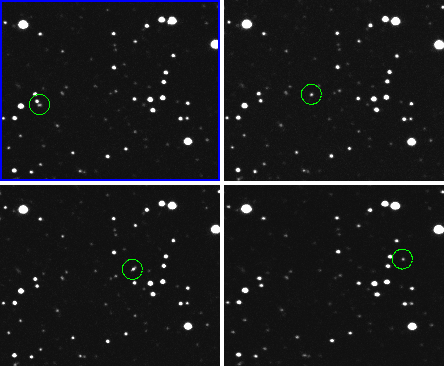
Asteroid 2012 KT42: Very close approach to Earth today (29 May 2012) of ~5 meter NEO
Asteroid 2012 KT42

Discovery images of asteroid 2012 KT42. Credit: Catalina Sky Survey/Mt. Lemmon Observatory
Map of Transit

Newly-discovered asteroid 2012 KT42 is flying past Earth today (May 29th) only ~14,000 km above the planet's surface. This means 2012 KT42 will actually fly inside the Clark Belt of geosynchronous satellites. The 3- to 10-meter wide asteroid ranks # 6 on the top 20 list of closest-approachers to Earth. According to the asteroid's orbit, there is no danger of a collision. Even if it did hit, this space rock is too small to cause significant damage. It would likely disintegrate almost entirely in the atmosphere, peppering the ground below with relatively small meteorites.
Note: The close pass will occur at about 07:00 UTC (03:00 EDT, midnight PDT in the US) on May 29
Link: Universe Today
Link: Images from Flyby (courtesy of spaceweather.com)

Link: 2012 KT42 Page from JPL
Link: Blog post ( Remanzacco Observatory in Italy)
Link: Minor Planet Center on 2012 KT42
Link: Wikipedia page
23 February 2012
Asteroids, Comets, Meteors (ACM) 2012 Abstract Deadline
Asteroids, Comets, Meteors (ACM) 2012
Abstract Deadline Approaching
The Asteroids, Comets, Meteors (ACM) 2012 conference will be held May 16–20, 2012, in Niigata, Japan, at TOKI Messe (Niigata Convention Center). It is the premier international gathering of scientists who study small bodies. The ACM series began in 1983 in Uppsala, Sweden, as a means of bringing together different groups within the asteroid, comet, and meteor communities who do not often have the opportunity to interact. From this first ACM meeting, a regular conference began. The conference now takes place every three years, and it is the pre-eminent meeting for small-bodies research, with attendance usually in excess of 400. The 2012 ACM meeting will be the 11th in the series and will be the first held in the Asian region.
The scope of presentations and discussion is broad, including all topics related to asteroids, comets, and meteors. Examples include discovery and cataloguing of objects, observations of meteor showers by radar, modeling the gas production of comets, and plans for future asteroid sample returns.
The abstract submission form is available on the USRA/LPI website:
http://www.lpi.usra.edu/meetings/acm2012/
Abstracts (one page) may be submitted for oral or poster presentation. Authors are limited to ONE request for oral presentation, unless they are an invited speaker. The abstract submission is managed by the USRA (LPI) Meeting Portal. If you have not yet accessed the Meeting Portal, you will be requested to create a personal profile before the abstract submission. ALL abstracts MUST be converted to PDF format before submission.
Schedule:
28 February 2012
Abstract deadline
Deadline for Financial Support Application (if possible)
15 March 2012
Deadline for early registration at reduced rate
Deadline for visa assistance
31 March 2012
Conference program available on website
16 May 2012
Open for on-site registration
For more information, visit: http://chiron.mtk.nao.ac.jp/ACM2012/
or contact: ACM2012@pub.mtk.nao.ac.jp
http://chiron.mtk.nao.ac.jp/ACM2012/
07 February 2012
Reports from Action Team on Near Earth Objects at 49th COPUOS Scientific and Technical Subcommittee Meeting
Action Team on Near-Earth Objects provides an update at the forty-ninth session of the Scientific and Technical Subcommittee of the Committee on the Peaceful Uses of Outer Space that was held from 6-17 February 2012 at the United Nation Office at Vienna, Vienna International Center, Vienna, Austria.
Scientific and Technical Subcommittee: 2012
Forty-ninth session 6-17 February 2012 Near-Earth objects
2011-2012 Draft recommendations of the Action Team on Near-Earth Objects for an international response to the near-Earth object impact threat
Link: PDF document (English)
Near-Earth objects, 2011-2012 Interim report of the Action Team on Near-Earth Objects
Link: PDF document (English)
Link: Online documents (Scientific and Technical Subcommittee: 2012)
Scientific and Technical Subcommittee: 2012
Forty-ninth session 6-17 February 2012 Near-Earth objects
2011-2012 Draft recommendations of the Action Team on Near-Earth Objects for an international response to the near-Earth object impact threat
Link: PDF document (English)
Near-Earth objects, 2011-2012 Interim report of the Action Team on Near-Earth Objects
Link: PDF document (English)
Link: Online documents (Scientific and Technical Subcommittee: 2012)
29 January 2012
NEOShield News ($5.3M EU Planetary Defense Study)
From a paper on the NEOShield project...
There is currently no concerted international plan addressing the impact threat and how to organize, prepare and implement mitigation measures. We report on a new international project to address impact hazard mitigation issues, being the subject of a proposal to the European Commission in response to the 2011 FP7 Call “Prevention of impacts from near-Earth objects on our planet”. Our consortium consists of 13 research institutes, universities, and industrial partners and includes leading US and Russian space organizations. The primary aim of the project, NEOShield, is to investigate in detail the three most promising mitigation techniques: the kinetic impactor, blast deflection, and the gravity tractor, and devise feasible demonstration missions. Furthermore, we will investigate options for an international strategy for implementation when an actual impact threat arises.
From one of the articles on the NEOShield project...
In response to these worries, the European Commission recently decided to invest €4 million ($5.3 million) in the NEOShield project. An additional €1.8 million will come from scientific institutions and industry partners. Within three years' time, the experts hope to draw up a blueprint for a test mission. If it can find a financial backer, such as the European Space Agency (ESA), the mission could be launched as early as 2020.
In reality, however, a host of ideas have already been proposed for how to deal with an approaching asteroid. For example, there's the "kinetic impactor" idea, which envisions using a massive projectile to knock an asteroid off course. And there's the "gravity tractor" idea, which entails having a small probe hover near the asteroid and use its gravitational traction to deflect it from its Earth-bound course. Some have even proposed an approach to the problem that would involve launching an all-out attack with nuclear missiles.
"Of course, a lot of things have already been proposed," Harris says. "But, so far, most of them have come from a single institution, perhaps even from a single person. So it has been hard to pursue them." The new project aims to systematically investigate all of the mitigation methods that have already been proposed. "That will take place on paper and in lab experiments, since we don't have the money to do more than that," says Wolfram Lork, who handles the involvement of Astrium, a subsidiary of the European aerospace giant EADS, in the project.
Link: Space.com
Link: NEOShield paper (PDF)
Subscribe to:
Posts (Atom)