
From www.sei.aero/planetarydefense...
FOX 31 Colorado's Good Day morning show captured this amazing footage a meteor or space debris breaking up in the atmosphere during their Thursday morning show on January 4.
Link: Video
28 February 2007


27 February 2007
Image of Apophis
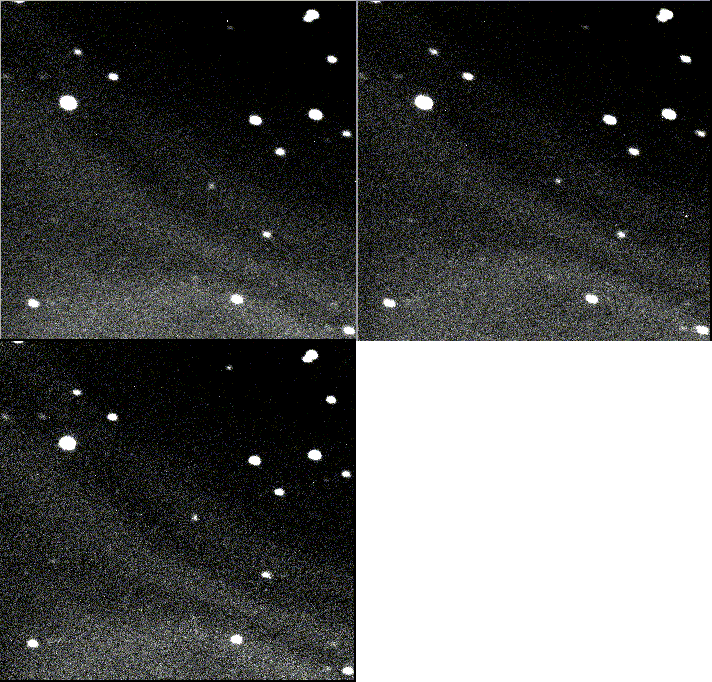
(99942) Apophis images taken by the Sormano Astronomical Observatory (Italy).
Link: Sormano Astronomical Observatory List of Imaged Objects (CCD images taken at Sormano on 30 December 2004)
Planetary Society NEO Event at the Upcoming Planetary Defense Conference
The Planetary Society is teaming with the Planetary Defense Conference to present a public event on the asteroid threat. From their announcement...
If an asteroid has Earth's name on it, how can we erase it? Earth's name -- not the asteroid! On Tuesday, March 6, The Planetary Society will team with the Planetary Defense Conference, a gathering of world experts occurring that week in Washington, to present "Earth Defense 101: Saving the Planet from a Killer Asteroid."
7:00-9:00 PM George Washington University Marvin Center Ballroom, 3rd floor 800 21st Street NW Washington, DC
A distinguished panel will discuss NEOs and planetary defense from many angles. Speakers include:- Rusty Schweickart, Apollo astronaut
- Tom Jones, former shuttle astronaut
- Don Yeomans, Jet Propulsion Laboratory
- Louis Friedman, Planetary Society Executive Director
Link: Planetary Society Website Annoucement
26 February 2007
Articles On NEOs (For Satire Only)
"International community skeptical of US claims of asteroid “threat”
Link: Article on SpaceReview
"Rogue Asteroid to Collide with Moon"
Link: Article from TheSpoof.com
Link: Article on SpaceReview
"Rogue Asteroid to Collide with Moon"
Link: Article from TheSpoof.com
Neil deGrasse Tyson Talks About His New Book (Including Asteroid Threat)
In his new book, Death By Black Hole and Other Cosmic Quandaries, astrophysicist and Hayden Planetarium director Neil DeGrasse Tyson talks about many topics in space and astrophysics. I believe there is also discussion of comets and asteroids in the book. He recently gave a talk on these subjects where he does mention the asteroid threat.
Link: c-span.org (booktv.org) video of Neil deGrasse Tyson talking about his new book, Death By Black Hole and Other Cosmic Quandaries
Link: booktv.org direct video link
Link: Amazon.com
Link: c-span.org (booktv.org) video of Neil deGrasse Tyson talking about his new book, Death By Black Hole and Other Cosmic Quandaries
Link: booktv.org direct video link
Link: Amazon.com
25 February 2007
Article on SpaceWorks MADMEN Concept

Here is an article from Richard Gray in the UK on the upcoming 2007 Planetary Defense Conference. It also includes a highlight of the MADMEN multiple mass driver concept that has been developed at my home organization, SpaceWorks Engineering, Inc. (SEI).
"Hollywood got it wrong, this is how you stop an apocalyptic asteroid"
Richard Gray
Science Correspondent
Sunday Telegraph
25 February 2007
Link: Article from UK Sunday Telegraph
Link: Article from Sydney Morning Herald
23 February 2007
Article: "UAH researchers working on laser system to deflect asteroid on collision path with Earth"
From the article:
UAH Laser Science and Engineering Group (LSEG), headed by Dr. Richard Fork, professor of Electrical and Computer Engineering, is conducting research into characterizing and deflecting asteroids that may endanger Earth.
The research has students excited about using lasers for space-related applications. Graduate student Blake Anderton wrote his master's thesis on "Application of Mode-locked lasers to asteroid characterization and mitigation." Undergraduate Gordon Aiken won a prize at a recent student conference for his poster and presentation "Space positioned LIDAR system for characterization and mitigation of Near Earth Objects." And members of the group are building a laser system "that is the grandfather of the laser that will push the asteroids," Fork said.
Fork said the current research relates back to work he performed in the mid-1980s, when he and other researchers at AT&T Bell Laboratories developed the first femtosecond lasers. They used one of the lasers to ablate material by ultra-intense laser pulses with femtosecond time resolution ("Femtosecond imaging of melting and evaporation at a photo excited silicon surface," M. C. Downer, R.L. Fork and C.V. Shank, Journal of the Optical Society of America B2,595-599 (1985)).
"The laser we are developing now is also being developed to ablate materials," Fork said, but the device would be "a substantial distance" from the target. The system includes an argon laser, a mode-locked Ti-sapphire oscillator, a regenerative Ti-sapphire amplifier, a doubled neodymium-yag pulsed laser and helium-neon line-up lasers, according to Dr. Fork.
The short-term goal of the work is "to amplify femtosecond pulses to high peak power at high average power for remote sensing," using unique features associated with the high pulse intensity, Fork said. The work is funded by the U.S. Army and involves a local company that employs several of Fork's former students. The research does not concern characterizing or deflecting asteroids, but Fork sees a connection.
Link: Article
UAH Laser Science and Engineering Group (LSEG), headed by Dr. Richard Fork, professor of Electrical and Computer Engineering, is conducting research into characterizing and deflecting asteroids that may endanger Earth.
The research has students excited about using lasers for space-related applications. Graduate student Blake Anderton wrote his master's thesis on "Application of Mode-locked lasers to asteroid characterization and mitigation." Undergraduate Gordon Aiken won a prize at a recent student conference for his poster and presentation "Space positioned LIDAR system for characterization and mitigation of Near Earth Objects." And members of the group are building a laser system "that is the grandfather of the laser that will push the asteroids," Fork said.
Fork said the current research relates back to work he performed in the mid-1980s, when he and other researchers at AT&T Bell Laboratories developed the first femtosecond lasers. They used one of the lasers to ablate material by ultra-intense laser pulses with femtosecond time resolution ("Femtosecond imaging of melting and evaporation at a photo excited silicon surface," M. C. Downer, R.L. Fork and C.V. Shank, Journal of the Optical Society of America B2,595-599 (1985)).
"The laser we are developing now is also being developed to ablate materials," Fork said, but the device would be "a substantial distance" from the target. The system includes an argon laser, a mode-locked Ti-sapphire oscillator, a regenerative Ti-sapphire amplifier, a doubled neodymium-yag pulsed laser and helium-neon line-up lasers, according to Dr. Fork.
The short-term goal of the work is "to amplify femtosecond pulses to high peak power at high average power for remote sensing," using unique features associated with the high pulse intensity, Fork said. The work is funded by the U.S. Army and involves a local company that employs several of Fork's former students. The research does not concern characterizing or deflecting asteroids, but Fork sees a connection.
Link: Article
22 February 2007
Waiting for Public Release of NASA Report to Congress on NEOs
Many of us are waiting for the public release of the December 2006 NASA report to congress on the next generation NEO search, characterization, and mitigation. This report should be delivered to Congress and hopefully both the executive summary and full report will be available from NASA sometime soon.
Both Lindley Johnson (NASA Headquarters) and Donald Yeomans (NASA Jet Propulsion Laboratory) are scheduled to talk about this report at the upcoming 2007 Planetary Defense Conference.
Both Lindley Johnson (NASA Headquarters) and Donald Yeomans (NASA Jet Propulsion Laboratory) are scheduled to talk about this report at the upcoming 2007 Planetary Defense Conference.
Subscribe to:
Posts (Atom)